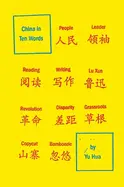
China in Ten Words - by Yu Hua 余华
Nothing is so likely to forge a connection between people as pain.
When in this book I write of China’s pain, I am registering my pain too, because China’s pain is mine.
We survive in adversity and perish in ease and comfort.
Adversity enhances our endurance, while ease and comfort tend to hasten our demise.
In the short space of thirty years, a China ruled by politics has transformed itself into a China where money is king.
Political passions that had accumulated since the Cultural Revolution finally expended themselves completely in one fell swoop, to be replaced by a passion for getting rich.
When everyone united in the urge to make money, the economic surge of the 1990s was the natural outcome.
During the Cultural Revolution, the definition of “the people” was workers, peasants, soldiers, scholars, shop clerks.
Now the expression “the people” has been denuded of meaning.
What other political figure would make a point of waving to his people in a swimsuit? Only Mao.
The word that has lost the most value the fastest during the past thirty years is “leader.”
In today’s China we no longer have a leader - all we have is a leadership.
During the Dragon Boat Festival of 2009 the following text message began to circulate:
«
New China News Agency, May 28:
The Chinese Academy of Sciences has successfully cloned Mao Zedong.
The clone’s physical indicators match those of Mao in his prime.
This announcement has elicited a powerful reaction internationally.
President Obama has declared that within three days the United States will repeal the Taiwan Relations Act and withdraw all military forces stationed in Asia.
The prime minister of Japan has ordered the demolition of the Yasukuni Shrine, acknowledged that the Senkaku Islands are Chinese territory, and approved reparations for the 1937 invasion of China to the tune of 13 trillion dollars.
The European Union has lifted its ban on arms sales to China.
Russia’s President Medvedev has conceded China’s claim to a million square miles in eastern Siberia.
Mongolia has signaled to the United Nations that it has always been part of China.
Taiwan’s President Ma Ying-jeou has promised to abide by all arrangements proposed by the mainland regarding reunification and has applied to be a scholar at the National Archives.
North Korean leader Kim Jong-il has sent instructions to his representative at the Six Party Talks to handle things according to Chairman Mao’s directives.
There has been a rapid turnaround in domestic affairs:
In just twenty-four hours officials from the county level and up have returned their ill-gotten gains, to the tune of 980 trillion yuan.
Privately run businesses have converted to public ownership.
25 million sex hostesses have become honest women overnight.
The stock market has soared.
House prices have declined by 60 percent.
The Chinese people once more are singing the anthem of the age: “The east is red, the sun is rising, / China has brought forth another Mao Zedong.”
»
Although life in the Mao era was impoverished and restrictive, there was no widespread, cruel competition to survive.
People then were on an equal level, all alike in their frugal lifestyles.
Today survival is like war.
The strong prey on the weak, people enrich themselves through brute force and deception, and the meek and humble suffer while the bold and unscrupulous flourish.
Mao Zedong Thought has not perished.
His ideas retain their vitality like seeds planted in receptive soil.
During the Cultural Revolution, Mao’s poems were put to music.
His quotations were sung by adults and children.
Mao’s poems and quotations were everywhere.
In our daily encounters with Mao’s pronouncements, the most ordinary things would take on weighty meaning.
As we got ready for bed, on our pillowcases we would read “Never forget class struggle” and, on our sheets, “Advance bravely through wind and waves.”
“Chairman Mao is at our side,” people used to say, and I believed that, too.
I was certain he’d be happy if I did something good and disappointed if I did something bad.
If it had been just a few people weeping, I would certainly have felt sad, but a thousand people all weeping at the same time simply struck me as funny.
One day when I noticed a poster with a cartoon.
My reading had finally discovered another new continent.
You may start off with an advantage, only to box yourself in over time, or sometimes you may start with a handicap, only to find it carries you a long way.
Writing enables me to claim ownership of two lives, one imaginary and one real, and the relationship between them is like that between sickness and health: when one is strong, the other is bound to fall into decline.
So, as my real life becomes more routine, my imaginary life is all the more brimming with incident.
My experience of growing up consisted largely of revolution.
When society undergoes a drastic shift, an extremely repressed era soon becomes a very lax one.
China’s high-speed economic growth seems to have changed everything in the blink of an eye, rather like a long jump that let us leap from an era of material shortages into an era of extravagance and waste, from an era when instincts are repressed into an era of impulsive self-indulgence.
One of Mao Zedong’s remarks sums up a basic characteristic of the Cultural Revolution:
“We should support whatever the enemy opposes, and oppose whatever the enemy supports.”
The Cultural Revolution was an era when everything was painted in black and white, when the enemy was always wrong and we were always right.
Nobody had the courage to suggest that the enemy might sometimes be right and we might sometimes be wrong.
Deng Xiaoping, in turn, said something that captures the zeitgeist of our current age:
“A cat that catches the mouse is a good cat, no matter whether it’s black or white.”
In so saying, he overturned Mao’s system of values and pointed out a fact long evident in Chinese society: right and wrong often coexist.
So China moved from Mao Zedong’s monochrome era of politics-in-command to Deng Xiaoping’s polychrome era of economics above all.
She said, “Money is not the sole criterion for judging happiness.”
I said, “If you are someone with an annual income of only 800 yuan, you will earn a lot of respect for saying what you did, but you’re not.”
The Rich List is popularly known as the Pigs-for-Slaughter List.
In China there’s a saying:
“People fear getting famous just as pigs fear getting fat.”
Reflecting the observation that fame invites a fall just as a fattened pig invites the butcher.
“Copycat” (in Chinese) originally denoted a mountain hamlet protected by a stockade or other fortifications.
It was also a name once given to the lairs of outlaws and bandits, and the word has continued to have connotations of freedom from official control.
“Copycat” has more of an anarchist spirit than any other word in the contemporary Chinese language.
As the copycat concept has gained acceptance, plagiarism, piracy, burlesque, parody, slander, and other actions originally seen as vulgar or illegal have been given a reason to exist.
And in social psychology and public opinion they have gradually acquired respectability.
In China today, in some spheres there is still a lack of freedom, while in others there is so much freedom it’s hard to believe.
More than twenty years ago I could say whatever came into my head when I was interviewed by a journalist, but the interview would undergo strict review and be drastically edited before publication.
Ten years ago I began to be more circumspect in interviews, because I discovered that newspapers would report everything I said, even my swear words.
Now I am often amazed to read interviews I have never given - remarks that the reporter has simply concocted, a gushing stream of drivel attributed to me.
“That was a copycat.”
That is our reality today: you may have done something illegal or unconscionable, but as long as you justify yourself with some kind of copycat explanation, your action becomes legitimate and aboveboard in the courtroom of public opinion.
When in 1966 Mao Zedong proclaimed, “To rebel is justified,” it triggered a release of revolutionary instincts among the weaker segments of society, and they rebelled with a passion.
Everywhere they rose up against those in positions of authority.
Traditional Communist Party committees and state organizations totally collapsed, and copycat leadership bodies sprouted up all over the place.
All you needed to do was to get some people to back you, and overnight you could establish a rebel headquarters and proclaim yourself its commander-in-chief.
Notice the parallel between the sudden appearance of myriad rebel headquarters at the beginning of the Cultural Revolution and the rapid emergence of the private economy.
In the 1980s, Chinese people replaced their passion for revolution with a passion for making money, and all at once there was an abundance of private businesses.
Just as the copycat challenges the standard, so too the private sector assailed the monopoly status of the state-owned economy.
Innumerable businesses soon went belly-up, only for countless others to take their places.
China’s economic miracle was launched in just this way.
Through its continual cycles of ruin and rebirth the private sector demonstrated its enormous capacity for survival, at the same time forcing ossified, conservative state enterprises to adapt to the cutthroat competition of the marketplace.
“Copycat” took on a rich new range of meanings, it has suddenly brought into view all manner of things that have been churning below the surface during these years of hectic development.
Copycat: that is the name they have all adopted.
Barefoot doctors were an invention of the Mao era: peasants with a smattering of education were shown how to perform routine medical procedures and then sent back home with a medical kit on their backs.
Why were they called barefoot doctors? Because for them practicing medicine was just a sideline activity; their basic work remained going out to the fields and laboring in their bare feet.
When peasants around them came down with some minor injury or illness, they would be in a position to provide basic treatment on the spot.
I used to be a copycat dentist.
Bamboozle: to mislead.
Hyping things up and laying it on thick.
Playing a con trick and ripping somebody off.
A social propensity toward chicanery, pranks, and other shenanigans.
Once these words with negative connotations took shelter under bamboozlement’s wing, they suddenly acquired a neutral status.
“Bamboozle” throws a cloak of respectability over deception.
Copycat phenomenon emerged in collectivist fashion, like bamboo shoots springing up after spring rain.
“Bamboozle” immediately took the nation by storm.
Like a rock stirring up a tidal wave it triggered a tsunami-style reaction as phenomena long existent in Chinese society - boasting and exaggerating, puffery and bluster, mendacity and casuistry, flippancy and mischief - acquired greater energy and rose to new heights.
Chinese homily:
“The timid die of hunger, the bold of overeating.”