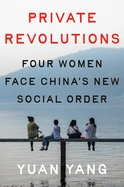
Private Revolutions - by Yuan Yang
“Generation Involution”: a system which absorbs ever more effort for ever less return.
The term, taken from anthroplogy, has recently become popular in China.
“Dive into the sea”: the term used for the risk-takers who set up businesses during the early days of China’s market opening.
In all rural schools, everyone boarded (lives at school) during the week.
The teachers thought they would be better at raising the kids than their parents, who had generally not finished school themselves.
The parents often agreed.
To their parents and high-school teachers, Siyue’s five dorm-mates were the ‘bad kids’.
They were at the private college because they had done poorly at the gaokao exams.
Their parents, mostly small-business owners, had enough savings to pay for a few more years of education.
To Siyue, her dorm-mates were the most human people she had ever met.
They had personalities, opinions, senses of humour.
They were down to earth, warm and curious about one another.
They were the opposite of the ‘good kids’ at Siyue’s high school, who were disciplined, cold and hypercompetitive.
Original thoughts would distract you from your studies, so the ‘good kids’ had to give up their personalities.
“Project 211”: group of elite universities.
They admit five out of every hundred students who apply, the same rate as Harvard University.
Beijing’s Peking University accepts just one in a hundred applicants.
The Chinese term for the nouveau riche includes the word for ‘earth’, which also means ‘unrefined’.
It brings to mind that, merely a generation ago, nearly everyone lived off the land.
Parents ‘injected kids with chicken blood’, jiwa, the slang term for turbocharging children by piling on after-school classes.
Her mother had wanted to build an additional house on their plot of land, but the local government had refused to grant her a building permit.
When the village party secretary visited Beijing for the annual ‘Two Sessions’ political convention, Siyue gave him a call.
She asked him how his journey had gone, asked after his family, and casually mentioned that she was in Beijing too, yes, working for CCTV.
She didn’t mention her mother’s request for a building permit, but by the time the party secretary returned to her home town, the permit was ready.
All he needed to know was that she was someone (important).
Benji, Xav and Siyue decided to test the waters with a summer camp for Chinese primary-school pupils in the Sussex countryside.
Benji had wanted to wait before launching the idea, to design proper brochures and a company website, but Siyue went right back to her CCTV colleagues and recruited six primary-school students straight away.
She knew that in China’s business world, the most important thing was to satisfy your customers’ desires as quickly as possible.
Left-behind children:
In the early 2010s, over 60 million Chinese children – one in five – lived without their parents. One in fourteen lived alone.
Politically:
‘left’ refers to people who support the status quo of the Communist Party’s rule, as well as to radical Maoists.
‘right’ refers to those in favour of democracy and free markets, and is associated with a more internationalised, younger generation.
In this respect, China’s generational connotations of left and right are the opposite of what they stand for in the West:
‘left’ = conservative past
‘right’ = brave future.
The average time a Chinese tech employee stays in their job is just eighteen months.
It pays to move around for higher salaries.
The pandemic: Beijing and Shenzhen to get back to business quickly.
But villages and smaller towns across China were more cautious and slower to reopen their borders, trapping the millions of migrant workers who had gone home for Chinese New Year away from their jobs.
As a result, cities suffered labour shortages, and workers were forced to drain their savings.
They came back to a city whose employment opportunities had also shrunk.
Kids nowadays don’t get married because they’re too smart.
They weigh up the pros and cons.
“We were all stupid when we got married.
Young people need to be stupid, too.
It’s best to be dumb at love and clever at work.”
Zhongkao, the high-school entrance exams that mark the end of nine years of compulsory education, and separate students into two educational pathways: academic and vocational.
Half of all sixteen-year-olds get into academic high schools.
The rest enter vocational schools or leave school altogether for work.
But her parents didn’t see vocational school as an option. They saw it as a failure.
Kids who ended up in vocational colleges also knew that was how they were seen by society.
China had rapidly licensed thousands of new vocational schools over the past two decades, enough to hold 10 million students a year.
The government wanted to model them on the German vocational training system, in which companies and schools partner to train secondary-school graduates.
A Shenzhen hukou gave her daughter an advantage over other migrant chidren without hukou.
Those students would have 100 points automatically deducted from their zhongkaoscores – roughly a fifth of the total points.
Meaning they would need to perform much better than ‘local’ students to be admitted to the same high schools.
We can never predict what political winds might change to make some previously safe topic politically sensitive.
Chinese economy 2023 slowdown is inevitable for a country that had been growing at breakneck speed.
Growth in the 1980s introduced an unprecedented level of social mobility by lifting people out of almost uniform poverty.
Now, class inequalities have set in once more, and the inevitable economic slowdown means it is harder to achieve any kind of mobility.