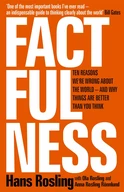
Factfulness - by Hans Rosling
People think the world is more frightening, more violent, and more hopeless - in short, more dramatic - than it really is.
Our cravings for drama are causing misconceptions and an overdramatic worldview.
When we realize we have been wrong about the world, feel not embarrassment, but that childlike sense of wonder, inspiration, and curiosity:
“Wow, how is that even possible?”
Embrace facts that don’t fit your worldview and trying to understand their implications.
Let your mistakes trigger curiosity instead of embarrassment.
“How on earth could I be so wrong about that fact?
What can I learn from that mistake?
Those people are not stupid, so why are they using that solution?”
Misconceptions disappear only if there is some equally simple but more relevant way of thinking to replace them.
People’s knowledge is outdated, often several decades old.
Their worldview dates to the time when their teachers had left school.
Update your knowledge.
Some knowledge goes out of date quickly.
Technology, countries, societies, cultures, and religions are constantly changing.
Collect examples of cultural change.
Challenge the idea that today’s culture must also have been yesterday’s, and will also be tomorrow’s.
The vast majority of the world’s population lives somewhere in the middle of the income scale, not extreme poverty.
Their girls go to school, their children get vaccinated, they live in two-child families, and they want to go abroad on holiday, not as refugees.
Step-by-step, year-by-year, the world is improving.
Only 9 percent of the world lives in low-income countries.
There is no gap between the West and the rest, between developed and developing, between rich and poor.
We should all stop using the simple pairs of categories that suggest there is.
Human beings have a strong dramatic instinct toward binary thinking, a basic urge to divide things into two distinct groups, with nothing but an empty gap in between.
Good versus bad.
Heroes versus villains.
My country versus the rest.
Dividing the world into two distinct sides is simple and intuitive, and also dramatic because it implies conflict.
Journalists know this.
They set up their narratives as conflicts between two opposing people.
The fragile individual against the big, evil corporation.
Negativity instinct: our instinct to notice the bad more than the good.
There are three things going on here:
1. the misremembering of the past
2. selective reporting by journalists and activists
3. feeling that as long as things are bad it’s heartless to say they are getting better.
When we hear someone say things are getting better, we think they are also saying “don’t worry, relax” or even “look away.”
Things can be both bad and better.
We pay attention to information that fits our dramatic instincts.
We believe that the unusual is usual: that this is what the world looks like.
The image of a dangerous world has never been broadcast more effectively than it is now, while the world has never been less violent and more safe.
The fear instinct is a terrible guide for understanding the world.
It makes us give our attention to the unlikely dangers that we are most afraid of, and neglect what is actually most risky.
“frightening” and “dangerous” are two different things.
Something frightening poses a perceived risk.
Something dangerous poses a real risk.
When helping those in deepest poverty, don’t aim to do anything perfectly.
If you do, you are stealing resources from where they can be better used.
Paying too much attention to the individual visible victim rather than to the numbers can lead us to spend all our resources on a fraction of the problem, and therefore save many fewer lives.
Items on a list: just a few of them are more important than all the others put together.
To avoid misjudging something’s importance, avoid lonely numbers.
Never, ever leave a number all by itself.
Never believe that one number on its own can be meaningful.
If you are offered one number, always ask for at least one more.
Something to compare it with.
Number in a news report triggers an alarm:
What should this lonely number be compared to?
What was that number a year ago?
Ten years ago?
What is it in a comparable country or region?
And what should it be divided by?
What is the total of which this is a part?
What would this be per person?
Preference for single causes and single solutions:
Being always in favor of or always against any particular idea makes you blind to information that doesn’t fit your perspective.
Instead, constantly test your favorite ideas for weaknesses.
Be humble about the extent of your expertise.
Be curious about new information that doesn’t fit, and information from other fields.
See people who contradict you, disagree with you, and put forward different ideas as a great resource for understanding the world.
Look beyond a guilty individual and to the system.
Every activist exaggerates the problem to which they have dedicated themselves.
It hurts our ability to develop a true, fact-based understanding.
Urgency instinct:
The call to action makes you think less critically, decide more quickly, and act now.
Relax.
It’s almost never true.
It’s almost never that urgent, and it’s almost never an either/or.
The constant alarms make us numb to real urgency.