Japanese addresses: No street names. Block numbers.
I love learning something that flips my head upside down. So, let’s look at one of the coolest head-flippers I’ve found: Japanese addresses.
Imagine you’re standing in Chicago and a Japanese man asks you, “What’s the name of this block?”
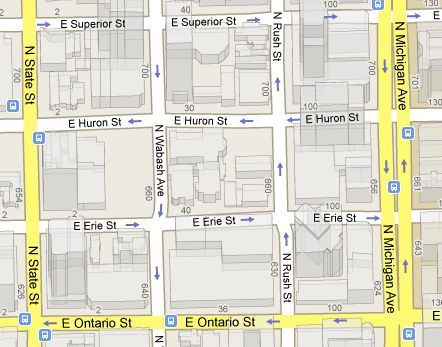
Thinking you’ve misunderstood the question, you say, “This is Erie Street. We’re between Wabash Ave and Rush Street.”
But the man asks you again, “No. Not the streets. The block. What’s the name of this block?”
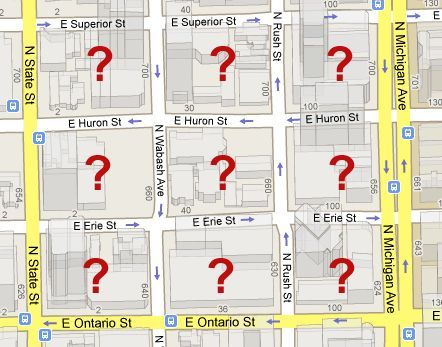
You say, “Uh. That’s the block between Huron and Erie, between Wabash and Rush.”
Blocks don’t have names! Streets have names! Blocks are just the un-named spaces in-between streets.
He leaves disappointed. You shrug and continue watching the gorgeous people of Chicago.
Now imagine you’re standing in Tokyo. You ask someone, “What’s the name of this street?”
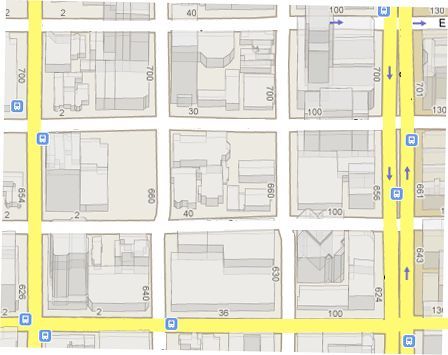
Thinking she’s misunderstood the question, she says, “This is block 5. That is block 8.”
But you ask again, “Huh? No. Not the block. The street. What’s the name of this street?”
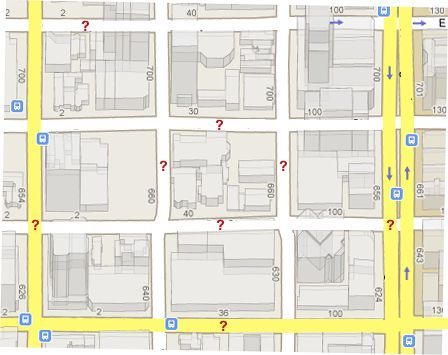
She says again, “Uh. This is block 5. That is block 8.”
See: In most of Japan, streets don’t have names! Blocks have numbers! Streets are just the empty space in-between blocks.
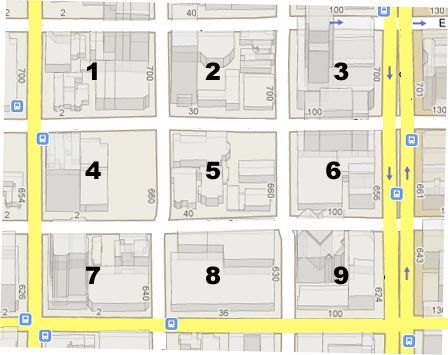
And the buildings on the block are numbered in order of age. The first building built there is #1. The second is #2, even if it’s on the opposite side.
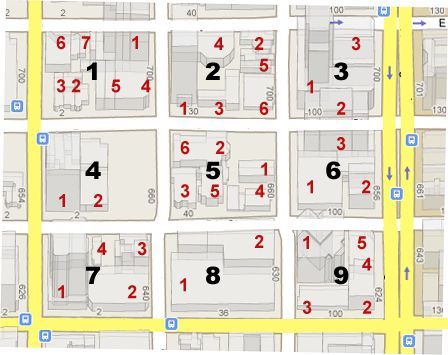
Mailing addresses in Japan, after naming the province and city, are a series of three numbers: district number, block number, building number. That’s how the building is found. No street names.
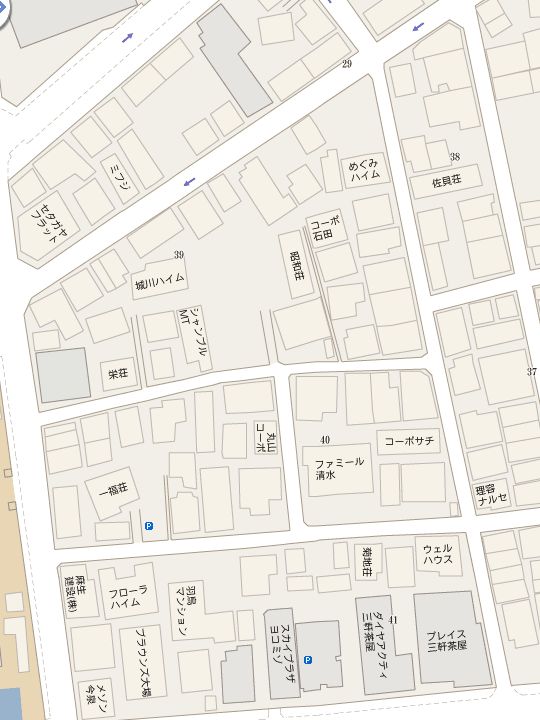
As an example, look at a map of Tokyo. Notice the blocks have little numbers on them: 29, 39, 38, 37, 40, 41. And the street names really are empty.
See the Wikipedia page for the Japanese addressing system if you are interested in learning more about that.
This makes me wonder what other assumptions I’ve been making in my life or business, that could just as easily be the opposite.
The beauty of being an ex-pat (even if you're not too thrilled with your overseas residence) is how many basic assumptions are challenged. It's also a headache when you're back home trying to explain it to people, though now it's a little easier because you can show them pics and maps online.
Another important difference between U.S. and Japanese street addresses is the layout of the streets themselves. U.S. cities are relatively grid-like; the streets pretty much go straight and plots are in even sized blocks. Japanese streets wind in all sorts of odd directions and some could be mistaken for alleys. The positioning of the houses on a block is equally baffling with odd shaped plots stuck in the tiniest cracks and crevices. Confusing when you're looking for something (directions must always include landmarks) but lots of fun when you're wandering around exploring a neighborhood.
i love how we seem to get so caught up in our own sphere of reality that a different form of logic can startle us. It's no wonder we're not yet ready to meet our neighbours in space!!!
On one of the streets where I grew up in Jakarta, the building numbers aren't ordered.
@jj vicars
Depends where we're talking about. Kyoto and Sapporo are about as grid-like as it gets.
Great post by the way, I actually was the guy asking the street names more times than I can remember!
My American son has a north Korean girlfriend in Tokyo.
We have been emailing. I asked for her address so I could send her a post card from New York City.
Please help me to find the right format for this as it came in an email from her. I am sure it was translated, so there lots of those little boxes but this is what I got from it:
1 10 7 404
Tokyoto adatsiku nisidakenotsuka 404
Thank you.
I love this. 3 years ago I was touring in Japan and I constantly had this headache! Where actually is the gig?!?! I get it in theory, but when I'm standing on the street, with guitar in hand, it's very different! ha ha
Thank you so much for that information and also the link to the Google map. I am so amazed by this!
You are very kind to help me this way!!!
I used to joke that it would be a lot easier to find places if they had a unique number. Now I know there is a country which does just that. There is an old folks home one mile mile away -in fact it's a Christian retiral vilage with its own lake and is quite beautiful. A special bus I had booked went there by mistake but found me eventually so there is something to be said about numbers. The Japanese people are lovely as well as clever. Maybe we sould take a leaf out of their book. I speak from experience. Thanks for having this page up Derek -I learn something from you yet again without even having to leave my modest little home. Thank you so much!
Denver, Colorado has a street naming convention that really threw me when I first got here: street names extend all the way north/south or east/west, even if the street does not. Thus "Daniel Street" may appear in one long stretch across town, while "David Street" is broken into dozens of little snippets -- but they'll all be lined up with each other either n/s or e/w. Once understood, the system works very well, but the first time you try to find a street on the map can leave your head spinning.
I work for the USPS. A few years ago we had a guy from Japan work for us briefly I might add. He had a really hard time delivering mail here. He couldn't catch on to the numbering system here. Now I understand why.
Thank you again! My postcard from New York City reached my son's girlfriend in Tokyo with the address help I got here! I was thrilled to send off an actual piece of mail while on vacation vs. email. Something to handwrite, send something real. Electronic is great, but a personal touch is nice too sometimes!
Thanks again.
You think that's weird, in San Francisco they don't use exit numbers!
The important thing I took away from reading this is how it related to your most recent essay of today (2009-10-09) "How do you grade yourself?"
The question is raised: How does our perceptions and measurements of our environment affect the manner in which we measure our selves? And vice versa.
So very interesting and assumption-challenging, Derek. Your other post about how bands might try flipping around the assumptions we usually have selling CD's has also gotten me thinking about music teaching. I wonder what could happen if I started offering the classes, like a Fiddle Ensenble, which I really WANT to teach and let people pay what they could. It may or may not work, and the biggest problem might be people taking advantage of it, but, I am continuing to ponder it and want to try it out when the time is right.
This is good to know. I wondered about all of those numbers.
I've also been wondering if there are any nations that actually use GPS coordinates or lat/long. It would sure make finding places a lot easier. And with zip+4, now at 9 digits, you could have the actual position in 12 digits.
When I first got to Japan in the summer of 1968 I didn't leave the hotel (the Tokyo Okura) without a map of my location written in Japanese. I made it a point to have knowlege of a few words. "Left, right, stop, thank you, please, and straight ahead." There weren't many foreigners living in Japan at that time so I was looked upon with great curiosity. A foreign teenager with a Rolling Stones hair style in 1968 was something most Japanese had only seen in magazines and on TV. Before I even had made a record there, girls would scream and run after me in the street thinking I must be part of a famous British band. To be honest, I loved the attention.
Things got even better when I got a record deal in the winter of '68 and started touring there. There are so many towns to tour in Japan, and back then in many they had never even seen a foreigner except in the media.
As you say, in Tokyo the addresses were defined by blocks, and bridges, which were pedestrian walkways to help traffic move more smoothly.
I left Japan in 1974 to live in London, missing the Japan fiscal "boom" by a year or so. Bad timing, but I'd had my fun and was a pioneer in the music world there as a foreigner in the local Japanese scene, the only gaijin accepted in the Group Sounds circuit.
Well, fortunately, I put such a high estimation on growth and learning that I've pretty much set things up so that my subconscious begins to look for assumptions that are limiting if I'm not growing and moving forward in my life. One's system of values is everything in life!
You are on a roll these days Derek!!!
Anyhow, you always have something interesting to share with us. Thanks for keeping the inspiration going! I hope to see you/talk to you in person soon!:)
Speaking from 20+ years in Japan: Yes, the block system is interesting; nice to see an overview here. But if I may send a friendly note to commenters overall: let's not go overboard with the "ooh, how unique!" bit, or contrived cultural explanations. Cities or neighborhoods that developed as mazes of twisty, splitting streets can be found all over the world, and a street-based address system won't work well in those. (For the record, too, streets of reasonable size *do* have names in Japan, though it's true that those aren't used as the base of addresses, even in Japanese cities or neighborhoods that are laid out grid-like.) It's all interesting stuff, but not unique to Japan.
Nice - that's something new I've learned today - thanks!
You think Kevin's explanation of Japanese grammar is similar to unix date format (yyyy-mm-dd)? Well guess what, yyyy-mm-dd is how the Japanese commonly write Gregorian dates (actually more like yyyy年mm月dd日).
私は インドネシアに23年住んでいて
日本から引っ越してきて 10年以上たってから 気づきました。 ここも
同じです。 でも 気づいた時 誰かに 変に興奮して だれかに伝えたかったです。 気持ちわかります。
It's funny you used Chicago as the example map - it does (did) use blocks, as seen here: www.encyclopedia.chicagohistory.org/pages/11175.html Block 37 is very well known locally actually.
Looks like this is how Sudoko puzzles were developed!
If the houses are numbered by age, what happens when an old building is torn down and then a new one built on that plot of land?
Example: Building 1 (the oldest one) is torn down. There are 5 buildings on the block. So is the new building still #1 (the newest building is now coded as the oldest) or is it #6 and there is no longer a #1?
it is simple - the logic behind it is since in the old time the land is much bigger, emptier & people usually use important building for landmark & tradition just keep pass down. So even now they have section up into small block by the streets still carry the traditional way, This system is only good for the people who grow up in the area so they slowly memorize the landmark... luckily there is google map now.. imaging to look up one building's name in Tokyo
Effectivement il y a de quoi se retourner la tête. L'avantage c'est que cela peut nous sauver si jamais on est perdu à Tokyo.
On comprend mieux les origines du sudoku avec tous ces chiffres (district, bâtiment...)
muy interesante jeje como no todos pensamos igual :D pero es bueno saberlo como cultura general
I live in Japan and I didn't know they were numbered by age...
Just to make things clear: The major streets of cities have names. I live in Wakayama-city and we have Chuo Dori (Chuo means central and Dori street) and Kokutai Doro. (I think it's national road. We also have Keiyaku Dori, named after a type of tree bording it.
Anyway, most streets have no name (as in the U2 song) and it is confusing as hell to find a house with the address. Some streets are so narrow, a car cannot pass. YOu should see my neighborhood.
Muy interesante nunca lo habria imaginado =D siempre es refrescante aprender algo nuevo gracias X3
Grand merci pour cette hallucinante info, finalement cela pourrait s'avérer très pratique pour ceux qui ne savent lire ou décrypter les hiéroglyphes japonais !
When you're lost in many cities of named streets without a map and where few passersby can understand you, if you're two streets off, you might never know your destination was just around the corner. In Japanese cities, you can usually circle in on your destination with just a few numbers and a neighborhood name. As a walker and foreigner, it's a fantastic way of getting comfortably lost in a strange land. If you enter a new neighborhood, you know you need to go back. If the numbers are going the wrong direction, the same thing. Sometimes the building, your physical destination, will be hidden, but because all of the other numbers are right, you'll know you're not truly lost. And upon finding your destination, if you've found it on your own, you might feel some of what jungle explorers of the past felt finding their hidden city in the mist.
There are also maps everywhere and more than a few helpful people.
Les verbes hausser, continuer, laisser sont à conjuguer à la deuxième personne du pluriel.
haussez, continuez, laissez.
trés bien
You have the system down. I live in Tokyo, and I've gotten so used to the system here that when I went to Philadelphia to see the rest of my family, I was asking people for a block number! They told me that I was in the wrong country, and that we have street names, not block numbers. I was sooo embarrassed!!
I had a different experience in Costa Rica. Usually directions by landmarks. Sometimes museums,statues, bridges etc. My favorite was the direction from a tree that had been cut down years ago. The directions were to start at the tree that hadn't been there for years.
Very helpful, Now I need to get a ticket to Japan so I can make use of new information.
Yeah it's a bit weird here in Japan. Everyone gives directions with landmarks...which is hard if
thing to read and learn about, but you present it in a very simplified manner.
Been browsing through the comment and didn't see anyone mentioning Venice.. though with your selfconfessed computerlike way of how your brain works you'd probably get annoyed by it.. The geography section of the wikipedia page explains some of it.
greetings Natasja
Amazing job at understanding this man. Seriously this would drive me crazy! I just moved to an area where the streets are named under Birds. So if you're not a bird expert, you're pretty much lost.
Seriously, how did you do it. O_O
Honestly thank you for this 'cause I'm very eager to go to Japan, but these streets are just insane!
Friends of me ask me what is seo all the time, but after this they can ask me about Japanese streets as much as they want! ^^ thank uuuu
This is some real interesting stuff...blocks are just pieces of land. I think I need to visit Japan in order to have an idea of this. The mailing addresses is really interesting.There are many places where there are confusing addresses.
That was a wonderful post! Thanks for sharing your knowledge with us! I hope to read more of your post which is very informative and helpful to all the readers.
I know this if off topic but I’m looking into starting my own weblog and was curious what all is needed to get setup? I’m assuming having a blog like yours would cost a pretty penny? I’m not very web smart so I’m not 100% sure. Any tips or advice would be greatly appreciated. Thanks.
Go to wordpress.com - it's free and great. — Derek
actually, i prefer the street name system. it provides a loose connection between blocks and/or buildings. e.g. you can say to a tourist: just walk down the xyz-street and you'll see this famous building and that famous square.
or e.g.: stay on the abc-street and you get directly to place d. sure, you can also tell the person to start beside block x and stay on the same street. but on the way to the destination it isn't posibble to check if one is still on the correct street, if it has no name.
nevertheless i respect the block-number-system :-)
We use the same system in the US, it's just not used by the common person. Talk to your local building department or public works department and you'll see.
I've been in and out of Japan my whole life, and have actually lived here for the last 2 years and I FINALLY know what's up with the lack of street names here- Thank you!!!
I find it funny that they don't really have a word for "block" though, as in "walk 3 blocks, then turn right." le sigh.
I know a place in the Philippines where they use both. It's not confusing at all.
That's the way Japanese thinks maybe lacking of streets name in Japan has a purpose who knows they are very strategic nation. I watched Japanese movies the enemies attack to the street then they trap after all. I know you know what I mean.
Thank you sir ! Very interesting. I stumbled upon this when I was reding an article on a Distributed Version Control System - Mercurial (hginit.com) and it's interesting because the author has done a brilliant job of describing a concept using the same addressing system. I am equally thankful to you too for having written this post, as much as I am to him... needless to say, you're writing style indeed is captivating (no wonder you have so many comments). wish you the best sir :)
I know a place in the Philippines where they use both. It's not confusing at
I have been to Japan many times, and have ridden a motorcycle several thousands of kilometres through cities and rural areas, and have to say that block numbering is not cool at all. Even they have problems with it. There are local maps stuck on a fence or prominent wall showing the location of each resident, but they are hopelessly maintained. Paper maps are often symbolic rather than representational, and rely on you finding a local to get you to your destination.
GPS's work by typing in the land line phone number of the person you are going to see. This means the TelCo has to geo-reference every number as they are allocated, and must be constantly maintained to retain accuracy, and expensive job.
The whole system relies on transient knowledge. A static road name and a static and rationally organised number would ease navigation. I recall a Japanese guy visiting London being amazed about the simplicity of finding a place without prior knowledge or reference to locals.
Yes it is fun to discover that another country has developed a system you thought couldn't exist, but it is not easy for the Japanese either, so all in all, one of those entrenched branches of human endeavour that is inefficient and not one anyone else would willingly emulate.
I live in Caracas, Venezuela. We started out (in colonial times) by naming city blocks (usually after particularly memorable or boisterous tenants). Interestingly, we had "invaders" too, like Hepkess said. They were pirates, rather than samurai.
As the city grew (quite explosively in numbers) at the start of the 20th century, the people moving in got lost. A lot. The block names were replaced with block numbers and lo and behold! The problem actually got worse!
A massive effort was undertaken to name all the streets, number the buildings on the street, and erase the block names and numbers from people's speech. Since streets here are quite long, this helped.
To a point. Newcomers still didn't quite get why a street named "Bolívar" should intersect with a street named "Mexico". So, like JJ Vicars, our "directions must include landmarks".
We are numbering streets now.
Therefore, I think it's only a matter of time before the Japanese go that way as well.
It really help me to find definite meaning of expressing Japanese address. I am now looking for a translation for one of my friend who is in need to understand a address in Japanese.Thanks a lot for your effort.
I found this piece of info very amusing indeed.
As a side note it was by challenging his own assumptions about the world that Descartes came up with his "Meditations on first Philosophy"(en.wikipedia.org/wiki/Meditations_on_First_Philosophy) Although he didin't manage to really discard them all and his logic was a bit faulty at some points it is really interesting and cool.
I work for the USPS. A few years ago we had a guy from Japan work for us briefly I might add. He had a really hard time delivering mail here. He couldn't catch on to the numbering system here. Now I understand why.
Do you mind if I reblog this?
Feel free to re-post anything on my site. Please just link back to sive.rs/ — Derek
Amazing how simple things as an address can make you think on how other cultures think differently from ours. Different solutions for the same problems. Thanks for sharing.
In Tokyo I have been confused by the "You are here maps" because they don't necessarily have north at the top. I think they are aligned like a panorama guide. So if you happen to be facing south, the top of the map will be what is south of you, and the foot will be what is behind you to the north. This makes sense, but is quite mind bending for someone brought up knowing the top of a map is north.
Thanks for presenting the Japanese "address" "system" (yes, separate italics) in a positive light. It causes no end of confusion for everyone. In the past, local police boxes were kept busy with people asking for directions. Now, most cars and individuals have Google Maps or another navigation system, but it's still a challenge. By the way, the chronological numbering of blocks and buildings is not prevalent. It is merely one of several methods that are used, with no consistency even within the same local area.
This has caused a bit of an argument in my family. Using the Japan Post HQ address as an example: The Japanese order of writing the address in Japanese is understood, and there is no misunderstanding when kanji is used example 100-8798 Tokyo......Kasumigaseki 1 chome 3 ban 2 go, or even in Japanese with 1-3-2 at the end of the kanji address without the chome/ban/go characters. See www.schoolpost.jp/pdf/nenga_dm_highschool.pdf as an example.
But apparently the old style of writing an address in English was 3-2, Kasumigaseki 1-chome, Chiyoda-ku.... and the older Japanese people I know have referenced their address and written their meshi as "3-2-1 Kasumigaseki, Chiyoda-ku.....". Which is opposite of the modern convention.
The official Japan Post web site www.post.japanpost.jp/english/index.html does not provide any guidance on how to address a letter going to Japan; they only advise how to address a letter being sent from Japan to overseas. I guess we are all just supposed to know how.
Using their own HQ example at www.post.japanpost.jp/english/about/index.html
and Google Maps, we can figure out that the new official way to write the address is
1-3-2 Kasumigaseki, Chiyoda-ku, Tokyo 100-8798
Note that Google Maps does not display a link to Kasumigseki 1-chome, only to 2-chome and 3-chome. So it took some clicking around to confirm correct info.
I get interested about how they did addressing, but imagine i am in Somaliland (Ex.north part which broke away from Somalia 1991) and I am trying to make addresses with our streets and building which doesn't exist in here.
you are welcome if you want to help me.
Just want to know his address in Japan
Mr. Shota aiba
First day on the internet? Welcome! ☺ — Derek
i am scare to travel to japan untill it has the street system like every other countries
Another assumption you might make is that black means death. Actually, in Japan people wear white to funerals, so they advise against sending anyone white flowers.
Another assumption is that, on a submarine, when you have you have inputted all the data into a torpedo firing computer a light will go on to show "ready." Actually, in Japan a light goes off.
I find this very curious. It makes me think of that adage "A block makes a difference". I'd like to think that each block in Tokyo has its own personality and sorts of tenets. and to know that the oldest building in the block is numbered the first makes a-lot of sense and adds a sense of oft mystery to it.
I was born in japan and lived at this address 108 Aoyama, minami-cho, 6-chome, minato-ku, Tokyo Japan and I am trying to find this address in a current map to no avail. Can you suggest how I would go about finding that address?
Thank you
i- *mind blowing up*
this would be just so confusing to me but i understand it at least.
Brasília, a planned city where I was born, is somewhat like this. The blocks' numbers follow a cartesian coordinate system around the city centre (Plano Piloto). www.google.com/maps/place/Bras%C3%ADlia,+DF,+Brasil/@-15.8042954,-47.8995706,15.67z/data=!4m6!3m5!1s0x935a3d18df9ae275:0x738470e469754a24!8m2!3d-15.7975154!4d-47.8918874!16zL20vMDFoeV8?entry=ttu