The joke that changed my life
Growing up in America, I didn’t know much about other cultures.
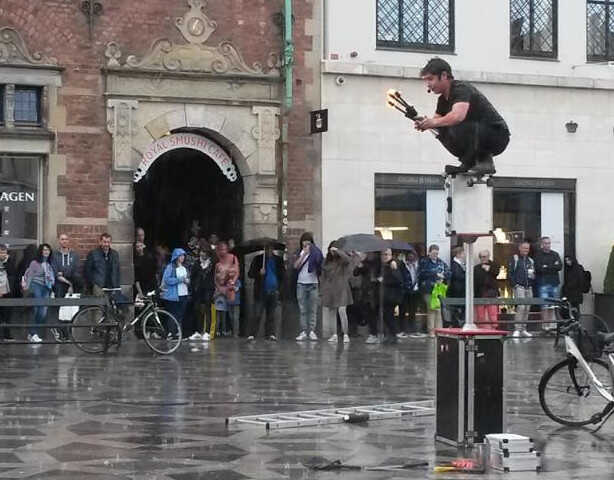
When I was 25, my band got some gigs in Europe — my first time there. It was 1995. The European Union was new. I heard a street performer in Copenhagen tell this joke:
“The EU will be a success if …
- the British are the police
- the French are the chefs
- the Italians are the lovers
- and the whole thing is organized by the Germans.”
“The EU will be a disaster if …
- the British are the chefs
- the French are the police
- the Germans are the lovers
- and the whole thing is organized … by the Italians.”
The European crowd all laughed. They seemed to know the stereotypes in the joke. But I was confused. I could figure out the French chef and Italian lover, but the rest were a mystery.
That night I bothered my Danish host for hours, asking him many questions like, “Do the French have bad police? Why are the Germans supposed to be so organized?” He was patient and tried to explain. The stereotypes had no malice. It was an affectionate tolerance, like we are with family members. Mom always loses her keys. Uncle burns whatever he cooks. Maybe it only happens sometimes, but enough to earn a reputation for it, which is enough to be teased for it.
But how can a whole culture earn a reputation? Why are some cultures one way, and other cultures another way? What makes millions of people in an area have similar behaviors?
Religion? A historical event that changed everyone’s actions and beliefs for a generation? Or is it actually just false, and based on one popular movie, like thinking all Australians are Crocodile Dundee?
They say that America is more individualist and China is more collectivist. But why? Does the influence of cowboys or Confucius still shape everything? Or is that the easy-but-wrong answer?
I have hundreds of questions like this, and I’ve been pursuing the answers ever since — for 27 years now! All because of that joke.
The best explanations I’ve found so far are the books “Au Contraire! Figuring out the French” and “Watching the English”.
Please let me know of any other great answers.
I always enjoy comparing cultures on Geert Hofstede's website (read his works as well, they have great insights): www.hofstede-insights.com/country-comparison/denmark,the-usa/
Now granted, this mostly explains the what, not the why, but even that is quite interesting and certainly useful if you are about to work or otherwise interact with someone from another country!
As a German I have to confess, the joke is 100% true concerning German's WILL to organize everything. But we have "fallen off the other side of the horse"
We TRY to organize but we over-organize so things are NOT working. Taxes, internet, university, vaccination... in international rankings we're not doing well at all. Concerning internet: we're second-last after Albany...
So the joke might have to be Rechnung-written: "The EU will be a success if... the Germans leave Organisation to the Italians."
Sad but true, as soon as governing officials are involved. We've organized us to death...?
One measure of one culture against another is what constitutes profanity. For e.g. in France, the expression 'merde' (shit) is closer to 'damn' or 'oops!'- no big deal, it doesn't raise eyebrows but in other European cultures and languages, usage would be frowned upon, at least in front of the kids, or maybe the priest.
In 1977 UK, the word 'bollocks' was 'legalised' when the Sex Pistols' album 'Never Mind the Bollocks, here's the Sex Pistols' was found in court not to be profane (aka indecent) because, the literal meaning of the word is 'small balls'.
dangerousminds.net/comments/rumpole_novelist_john_mortimer_defends_sex_pistols_in_bollocks_trial_1977
What is allowed and what is not allowed, what shocks and what raises a laugh are where cultural differences can be observed every day. When someone drops a plate, or realises they left their wallet in the car at the end of the meal, or can't contain their frustration, horror, or delight, the reactions will be formed by local mores.
I’ve heard it before. But including the Swiss. I think it was this flavor:
news.ycombinator.com/item?id=14583836
I’m French and I can attest French policemen can be vicious. Especiallly when it comes to car speed tests. While English police usually show when they do a speed test.The French hide it as much as possible.
About Germans I heard they are always are very disciplined when it comes to waiting for their turn to cross a walkway compared with the French. But I actually never went there.
About the difference about Asian and western cultures, there are some indicators in the book Quiet by Susan Cain, when it comes to culture induced introversion and extraversion.
Derek, hi~ Just wanted to let you know I've been pursuing these questions since Covid--gave up my apt. in Santa Monica and left the states--so far one month in Sicily, one month in Cordoba, Spain, one month in Sao Jacinto Portugal (by Aveiro), and now two months near Swansea, Wales with one to go before I head back to the "Schengens"--to France and mainland Italy each for six weeks—and then i don't know. And I've performed every place I've lived over here--formal concerts, and in parks ☺. I do have a sense of these personality stereotypes based on my living experiences, but that's a much longer conversation--or maybe a book, right?
All my best to you!~
kay
One aspect that can partially explain this is language.
In the US almost everyone speaks the same language, English. In Europe on the other hand, you have different languages right next door. You can make a wrong turn and start looking at signs in another language.
You can see something similar happening in South America. Most countries speak Spanish, so there's a common thread around most countries. There isn't a joke like this in South America.
That difference in language in Europe can translate in a different way of living life.
Of course there are many other factors in play, but language is a huge one, as the differences are reinforced from birth. Some languages have more words to express different kinds of things, and so on. Those differences grow larger as the people grow up.
Now hang on a sec… I must stick up for our (English) cuisine!! It’s become outstanding in recent years. However our government is a shambles
You know what, in fact I’m pretty sure the original hell version I heard with the Swiss was:
English: chefs (because of vinegar crisps, fluorescent peas and jelly)
French: organizers (because of the revolution and many strikes)
Germans: policemen (because of the nazi legacy and discipline)
Swiss: lovers (because well they like to be neutral)
Italians : bankers (because of the mafia and many pickpockets in the country)
Hi Derek,
As an Australian, I can say our culture of mateship, irreverence, humour, hard drinking, hard working, relaxed egalitarian attitudes are directly a result of our convict heritage.
Here’s a good article written by Miranda Luby for the BBC.
www.bbc.com/travel/article/20170607-why-are-australians-so-laid-back
Ps
My husband actually used to trap crocs for a living in his early days! (What a cliche!). He says read Robert Hughes, “The Fatal Shore” for a real perspective on early Australian slavery, which may go a long way to explain why we as a collective mistrust authority.
He’s happy to send you a copy.
I really believe that none of that accounts to a single event, this bigger traits commonly perceived in a given society are direct (but sometimes diffused) result of how a certain collective decided to deal with their hardships. They first had to deal with it using whatever resources they have at hand, and by resources I also mean soft skills more commonly found among that group. As a culture evolves the solutions they manage to find are passed along and updated so an archeology of sorts that you usually find in anthropology books are quite enlightening on this. Just as some studies in psychology and if one finally wants to get it after knowing a bit of this theory the natural step would be diving into the culture and developing an empathic link will eventually make them get it. Actually, empathy triumphs over all else, whenever one wants to understand someone else's (or someone else group's) way of living. We all fall victim of collective choices took in the past and the present but the most important thing is how the society chooses how to deal with those choices. Finally some choices favors certain traits so explicitly that it is easy to point out a stereotype, maybe the uncle always burns the food because he wants to take that extra minute to tell a joke or brag about something but the real bummer is the overcooked food so the rest goes unnoticed 🤷🏻♂️
Do you know the book „East meets West“ by Yang Liu? It‘s a small book that uses illustrations to compare cultural differences between Germans and Chinese. It‘s entertaining and though-provoking as well. Highly recommended.
Now, that got me thinking too……
It's not just countries, it's about regions within countries as well. Every country has its "redneck" in Spain it's the "cateto" in France it's a "péquenaud" in Ireland it's a "culchie" and in the UK it's a "bumpkin" why is it generally accepted in all societies that country folk are less intelligent and put less emphasis on cleanliness and style or other more sophisticated concepts than "city folk." In the UK for example most people from the "West Country" are considered to be "ooh arring turnip-eating bumpkins" and people from Cornwall for example don't even consider themselves to be "English" as Cornwall has its own native language and a strange dialect of English is spoken. Johnny Two Kebabs writes very eloquently about these issues in his latest novella "Johnny's Ridealong" www.amazon.com/dp/B0B3NGNRJR
Personally I don't think country folk are less intelligent it is just that they don't use their intelligence. Diversity and inclusion should include the bumpkin but he has to help himself for others to be able to help him (or her)
I think there's such a thing as national consciousness or identification, the way a country sees itself and what the people expect and think of each other. But I think when you take a fine-grained look at individuals, you probably won't find it to hold up.
Lots of Germans (I'm German) are tardy, laid back, and disorganized. Especially Bavarians in the south are more laid back. (See what I did there? Hehe). The idea of being organized is just that, an idea that took hold of the culture for whatever reason (I know that's what you're after, the reason). They're stereotypes, not realities.
Differences in customs are another matter. Customs, it seems to me, do have an effect on a culture.
And, as someone else mentioned, language has an influence. Heidegger (not endorsing him, he was a Nazi sympathizer) said that, to paraphrase him, everything arises in language. I think he went too broad because we're more than just our brains (our bodies have their own story about life). But if you're willing to read him (if you haven't already) he may give you some insight into some of the ways in which language and experience are connected.
If I were to look for an answer to your question, I might study transformative changes such as from hunter/gatherer to agrarian, to industrial. From nature worship to monotheism...those are changes that obviously took place in most of the world. But probably differently, depending on local resources, topography, climate, population density, and the like.
The clarity and apeture of our lens determines the impact and hilarity of the joke. Polish and expand as we all evolve ;)
Maybe this is an interesting point of view. The Mission of Folk Souls rsarchive.org/Lectures/19100616p01.html
Geography can have a huge impact on cultures and when mixed with human insecurity and uncertainty has the power to explain a country’s actions and policies. Things like rivers and mountains (or oceans in the case of the USA) isolating and/or protecting a country have far reaching consequences for how they interact with the wider world and develop. Robert Kaplan and George Friedman are the two individuals I have read the most on this subject.
I'm a Brit, but had european family and friends form the beginning. I remember hearing that many years ago, and in several incarnations too - usually it's "heaven and hell" not the EU.
One of the funniest related EU jokes I heard goes as follows -
An Englishman a Frenchman and a Spaniard are discussing sex and marriage.
The Frenchman says (in his typical accent) When I make the love to mah femme, I cover her body with perfume and rose petals, and she rises one meter off the bed in ecstasy ....
So the Spaniard says - eez nothing! When I make love to my senora, I massage her body with exotic oil and aromatics, and she rises TWO meters off the bed in ecstasy.
So to the Englishman (in a broad cockney accent). Nah that's nuffin mate! When I shags me missus I wipe my cock on the curtains. She hits the effin ROOF!
Agree with the first commented on Hofstede.
A good accessible book on the topic is culture map (summary: kathrynread.com/the-culture-map-by-erin-meyer-a-summary-and-review/ )
Unfortunately both official websites paywall the more detailed stuff. Also most discussions/summaries online aren't too helpful as 50% is caveats on how not everyone country x is like that, and how every culture is the best in their own way :)
My favorite book on this is “The Culture Code” by Clotaire Rapaille. He’s a cultural anthropologist and also a marketing expert who has used his insights to help companies successfully market their products in different countries.
You might enjoy One Man's View of the World by Lee Kuan Yew. He discusses his take on the future of countries that play a key role in Singapore's future, and makes a lot of his analysis and predictions based on the temperament and culture of the people in these countres.
I'm Spanish and, in general, I have stereotypes so much... but of course, I loved your blog post, and it planted a seed in me. My girlfriend is Chinese, I'll discuss this with her too. The topic is truly fascinating.
Many years ago I read a book called "Foreign to Familiar: A Guide to Understanding Hot - And Cold - Climate Cultures" and now I really want to revisit it with a fresher perspective.
btw I have no words to thank you for all the ways you impact my life.
Hey Derek,
isn't that true for the States as well?
I mean, there are stereotypes by each state, aren't they?
(Can't tell. Never left this continent I was born in). The people on the east are perceived differently than those in the west. North and south were at odds in the past.
You've got some book recommendations. I second Quiet. If I were to add one, it would be The Culture Map.
Now, my personal opinion as German:
It is influenced by geography. That is, what is the weather like over the turn of the year (Russians have way more… opportunity to spend time thinking on winter whereas French enjoy the life). What food you can grow.
But also the historical background. Germany had a strong army. Preussian state introduced track recording (birth register, everyone had to attend school, etc) with a rigor not known before (church kept track to a certain degree, but was … eliterian).
Now, the USA promised The American Dream. Every single person was meant to have the opportunity to become a millionaire when starting as a dishwasher. How much of it is true, I leave to yourself to judge.
China on the other hand was more influenced by its philosophers. That you can achieve more when the group is prioritised over the individual. I remember you shared that Aha moment once you spent a few years in Asia.
So far,
André
GH
As a South African / Swede living in the UK (mostly London’s cultural metropolis)… multi-culturalism has been fascinating for me. To witness the cultural effects on behaviours in a place like London is a bit of a deep dive into melting-pots. I studied cross-cultural psychology at university and found that really interesting to explore what is universal versus cultural etc. language certainly does play a huge role as a cultural expression and set of blinkers / guide rails for interpreting the world. I see that in my use of English versus Swedish versus Afrikaans. Now married to a French-speaking partner and raising multi-lingual children I’m determined for them to get the benefit of broader cultural experiences through language.
I think you’d be fascinated by the Law of Jante (en.m.wikipedia.org/wiki/Law_of_Jante) which permeates Scandinavian culture in so many ways. It’s a set of rules names after a fictitious person and it reflects a very socialist Scandinavian mindset. “It characterizes as unworthy and inappropriate any behavior that is not conforming, does things out of the ordinary, or is personally ambitious.” (Wikipedia).
It really helped me understand some of the Swedish quirks When I moved to Stockholm in the 90’s.
www.erartperu.org/post/la-oportunidad-está-en-nosotros
I'd be very careful about generalising behaviours based on country of origin, it could be perceived as a subconscious bias, but there are certainly personality tendencies in groups of people from specific regions, possibly due to traditional habits, genetics and cultures.
I must attest to the fact the Brits tend to think a cup of tea will solve everything and the weather is always too hot or too cold. The EU analogy is scarily accurate too (something still dividing the Brits after Brexit's impact).
I do find it fascinating how different cultures personalities are presented in media though. Stereotypes have a lot to answer for.
I do not like jokes like this because I am a black American who have been stereotyped all of my life.
So I am sorry Derek but do not find this funny.
I think of it like the north versus the south. I grew up in New York and loved it. Thought it was perfect. Left to live in the south. Had heard all of the stereotypes about southern charm and northern aggression. Never believing it. Then voila. I move south and see first hand the culture and upon returning home to NY felt the reverse. The stereotypes had legs. The why I surmise comes from collective decisions that win out like Lamarckian evolution. A group likes a way of being and pushes the agenda. It gains unconscious credibility and soon becomes an ethos. My 2 cents. Chris
One need only to drive on the M5 with a GPS to feel the CONSTANT presence of cameras and transparency.(big brother)
The Swiss police themselves. Try J-walking and folks will yell at you. It has to be the cleanest country in the world. No dumping or dog dirt. No slums. People are constantly painting and repairing any damage on homes or common areas.
Our Swiss German relatives are so organized that they have their lives planned out with goals and action plans for the entire family. No
Resistance or procrastination. They are focused!
While at MIDEM the food was divine💫 even the train station served the freshest delicious pastries. No second day bread anywhere. Salads are bursting with flavor.
Also they walk and take the stairs. No fat French.
Food is an Art, the taste, texture, placement, colour, nutrients.
Sophia Loren films probably portray the epitome of Italian romance.
Clark Cable didn’t have a chance.
Love the joke. So happy we traveled the world and experienced the fabulous people and their ways.
As always, you bring thoughtful brain storms!
Language helps to explain the Germans. It's a very precise and methodical language, and I'm certain that it reinforces that sort of precision in their general lifestyle.
Latin languages (e.g., French, Italian) are less rigid and more open to nuance...
Stereotypes exist for a reason, as do generalisations. They are patterns, and patterns save time and effort. That doesn't mean they're always accurate or reliable, and they aren't helpful at an individual level... but you need them for decision-making.
And you need them for jokes and humor. (My advice for those so easily offended... Don't open an email that mentions 'joke' in the subject line.)
A decent lighthearted look at the UK can be found in Bill Bryson’s Notes From A Small Island. It was a while ago when I read it but remember it as irreverent but also very astute.
I second the recommendation of "The Culture Map". It's insightful about how a lot of cultures vary on their orientation to time, hierarchy, etc. It's very good at avoiding delving into stereotypes, while outlining where people immersing themselves in a culture (with a focus on international consulting/management, but not limited to that) will routinely shoot themselves in the foot if they go in unaware.
As a Canadian, we're often described as "nice", which I've taken pride in.
Living in Toronto, it was once described as "New York, if run by the Swiss", which I thought was fair and funny. It was certainly not meant to denigrate. It doesn't put down New York or the the Swiss either.
Some stereotypes are loving and complimentary, and others obviously are quite harmful.
I'd be remiss if I did not mention the Nacirema. See what you think...
www.sfu.ca/~palys/Miner-1956-BodyRitualAmongTheNacirema.pdf
The 11th chapter of Genesis…Tower of Babel…God confused and divided and scattered the people by language. Distinctions and traits began there and have adapted and developed over generations. God’s design and plan…
Imagined Communities by Benedict Anderson was a big influence on my masters thesis. I wrote about suicide terrorism and the altruistic nature of those who give their lives for others vs the selfish reasons of others and how those reasons can be influenced by social and cultural scenarios - imagined communities.
I grew up as a "third culture kid" (de.wikipedia.org/wiki/Third_Culture_Kid). I spent my early childhood in Colombia, a few years in Turkey, most school years in Germany and the final school years in Italy. I spent my university years and the rest of my current live in Germany. My dad is south-american latino (Chile) and my mom was German.
This history gave me both an inside view and an outside view of different cultures. Doesn't mean I have all the answers (perhaps more questions still), but I now think that "culture" is an emergent phenomenon, similar to how the shape of a flock of birds is a characteristic, emergent phenomenon: Each individual bird doesn't know or aim to create the overall shape, but as a group, they do, yet it's the result of the sum of all birds that make up the flock and how they interact with each other and their environment.
Culture is the sum of individual histories, challenges, choices, and actions. The inputs are historic (as Germans, we're deeply influenced by our role in WW II, for example), geographic (warm climates tend to produce different cultures like cold, mediterranean vs. mountain, etc.), and external (environment, borders, geo-politic, economic, etc.).
Even within countries, there are differences: northern Italians tend to be slightly different than their southern cousins, same with norhern vs. southern Germans, etc.
Culture changes, albeit slowly. I'm not very happy about today's Germany being "less organized" than the joke hints it to be. Just look at some large infrastructure projects like BER airport and Stuttgart main train station, or the back and forth of Corona policies and actions during the pandemic. Maybe climate change will also lead to cultural change? Today, it's very hot here in Munich and everybody is in a chilly, lazy mood :).
I guess these conditions are a product of the long term consequence of mimetics. The desires of the individual are defined by the models of people/groups he compares to and validates himself. The individual also affects the desires of the group on a reflexive cycle. On long term diferences just keep growing and autocompounding.
Hi Derek, if you would deepen the subject, I would recommend an old book "We Europeans" by Richard Hill. Have a nice day!
I absolutely love the Xenophobe's guides, i read quite a few of them, they're amazing
Language structure and patterns definitely have something to do with it. Northern/Germanic languages tend to have more complex sentences which would mimic organisational skills. Southern/Romanic languages have more variety (cases/verb forms), which seems to relate to creativity. Same with melody.
The question is: did this come about because colder climates during longer periods of the year require long-term thinking and better planning which in turn favored more complex languages? While in the south, there was more time for social interactions which benefit from melody and variance?
I’d say the Xenophobes Guide to… [country], fits the request here very well.
www.xenophobes.com/
It’s very tongue in cheek, at times in depth, and reading your own countries “guide” alongside a foreigner makes you feel dressed down, bemused and utterly foreseeable.
I recommend giving these books a look :)
When I first went to France I was given an article by an American who was living in Paris for work. I clearly remember two suggestions in order to fit in better and get along while in France.
The first was to say hello in French when you walk into a small store. The boulangeries and other places like cheese shops etc. Americans have a tendency to treat people behind the counter as less than. “Just the help”. The French tree to proprietors and helpers at a business almost as if they were entering someone’s home. The second recommendation was to not yell everything you say. Americans tend to be at a higher volume with each other. The reason that the French can sit so very close together with people who aren’t dining with them directly, is that they don’t yell their conversations at each other.
I was telling this to a friend of mine who I traveled to France with years later. We had gone to a tiny French restaurant in Paris that was run by a family. We had gotten there early for dinner as the French eat at certain hours and we got there at the very earliest part of that timeframe. The family was wonderful and the husband was the chef and everyone came out to talk to us and serve our meal including the chef. It was a delightful experience. I was telling my friend about the volume of conversation comparison, and a few minutes later an entire group of Texans came in talking to each other as if yelling across a very large room (even though they were very close together). It was jarring after the very peaceful environment we had been eating in and both of us started just laughing because of the universe illustrating so quickly and bluntly the very thing I was talking about just a few minutes before hand. We both felt sorry for this small family handling this big group of Americans who were so boisterous, loud, and intense. Someone in the group mentioned that this place was recommended on some travel brochure and that’s why they all came. They were not all from the same family but they were on the same tour.
This is an example of cultural difference. I followed those rules and was treated very well everywhere I went. I didn’t understand the language and know that some people were rude about me at times (another stereotype about Parisians) but following these two rules has made my life very much easier whenever I travel to France. There are other rules that I don’t know but those two really set me in a good place as a tourist. The only other thing I do is also try really hard to understand and speak a language where I go so that they take pity on me and speak English. The effort does impress them because Americans have our reputation of thinking the English is the only language.
Thanks for bringing this up. Oh and one more thing. Canadians do have a reputation of being nice which I experienced when driving there. I got the impression that politeness is ingrained in the culture. For instance, I can put my turn signal on and other drivers actually let me into the lane.
None of these things is universal but there are areas in which you can see the stereotype of a culture showing up in their behaviors.
Ariana
I’ve lived in France for 38 years now, and the stereotypes that were true 27 years ago are, in my opinion, only partially true today. The historical reference to French cooking is accurate but Italian cooking is also creative, delicious and inventive. As far as “police” is concerned, the joke is probably referring to the disastrous handling of opposition to the Wars in Nortg Africa (Algeria) and the “civil rights” riots in May of 1969. The French are constantly on strike or marching for or against something or contesting the government so there have been a lot of opportunities for crack-downs.
Looks like you've been having fun for 27 years simply being curious. Maybe stay in the question?
Not a book. I would recommend that you watch a few episodes of a sitcom from decades ago called “All in The Family”.
It will become immediately apparent that the bigoted things Archie Bunker says are neither true nor funny; the humor is that anyone would be ignorant enough to say such things. We all laughed at Archie, not what he would say and do on the show.
The point of the show was to demonstrate the harm and counterproductive nature of bigotry/stereotypes, regardless of whether or not there is a case to made that a particular group of people may have, in general, a particular characteristic.
I've seen this joke countless times on tourist postcards. Everyone likes to make fun of other cultures, but it's just gentle ribbing. But as time has gone on, it's perhaps not completely accurate anymore. The Germans were once seen as ruthlessly efficient, but after living here for 21 years, I can tell you that that isn't the case anymore by a long shot. And obviously now, Britain is no longer in the EU, so we need to replace them with someone else in this joke!
And I thought the French were supposed to be the great lovers? As comedian Bill Maher once famously said "in France, even the mistresses have mistresses."
I'm sure there are similar jokes in Britain concerning England, Scotland, Wales, and Ireland. Friendly rivalry.
Learned behavior is truly fascinating, especially when regionally practiced.
Southern women in the US are a great example of a regional cultural expectation that creates behavior.
Gentle, kind, passive, deferring to the man, accommodating, hospitable - characteristics of a wonderful Southern woman. We'll welcome you in, offer you sweet tea, and smile & laugh while the men lead the conversations, then inevitably cluster for female conversation. It's an act we learn as kids.
Southern men are notorious for treating women as idiots and directing all questions to whatever man you are with, even when the woman is the business owner, not her husband.
For example, I'm the sole owner of an LLC & selling my business, yet the young male realtor continues to direct all questions and decisions to my husband, who has no legal authority to sign anything. The realtor knows this - I have told him, yet he continues. Rather than push it, I've resigned to letting them do their thing. When it's time I assert myself, but meanwhile I let them feel important. That's what we do.
Patrick Dempsey and Josh Lucas once asked me if I considered getting into acting. I smiled and cooly replied that it would be interesting to study the art. I was acting that very moment, and they had no clue.
Southern women are born actors. Being real is our challenge.
The most amazing conversations to be had are with southern women who trust you enough to quit acting. You'll hear the smartest, wittiest conversations from strong, intelligent women, and very quickly know the role we play is for our own amusement. We're not trying to be insincere, we've just learned bucking the system is tiring and unproductive. Being treated as equals happens, and we treasure those relationships, personal or professional.
If you don't play along with the cultural expectations, you're considered bitchy, pushy, mean, obnoxious, or my favorite, crazy. It's wonderful when we decide playtime is over and quit "hiding our crazy." We aren't bipolar, we've just had it, and you're about to experience "a shit show." There's no force to be reckoned with more powerful than an angry southern woman who sets her sweet tea down.
I agree with Sebastian (comment 6) about language shaping culture as well.
Southern dialects change drastically, though are usually lumped together by those who don't live in the South. Take 2 men from Leslie, GA (rural) and Auburn, AL (big town) - incredibly different Southern accents and different approaches to life. Leslie's sounds more country and has a longer drawl. Auburn sounds more sophisticated and Rhett Butler-ish. Auburn's dialect wants to impress you, Leslie's doesn't care but draws you in with it's musical nature. Leslie's you'd assume to be a redneck while the guy from Auburn you imagine plays golf daily and drinks bourbon on ice. In fact the man from Leslie owns 1000 acres and has travelled the world, while the man in Auburn makes $40k and hasn't been anywhere.
Language and dialect create assumptions about behavior and wealth, too. One of your commenters made the same assumptions about "bumpkins", illustrating rural vs urban stereotypes. The bumpkin on the little farm has no desire to live in a flat in the city, and vice versa.
Is there a place on earth where women are truly treated as equals and people are cherished for their character, not their location or assumed bank account? I'd like to live there and just be real.
There are 'small chunks' of meaningful data that once communicated don't change because people are too busy repeating that data's meaning. For example, most words are like this, we don't usually take the time to re-debate the meaning or use of a single word as we are busy using that word to do other useful things.
The small chunk of meaningful data is occupied. It is in active use, like a car or a part of a car. Culture is the same way- while on the outside it looks like a big scale thing(Britain is large) it's actually much huger than an outsider can perceive. For example, a local briton knows what manchester is while I do not.
As a cultural outsider you constantly have to transact in small chunks trying to grasp the bigger understanding of the culture at big scale. But here's the rub- people INSIDE the culture do this as well. So they accept French=cooks as a small chunk of meaningful data that is in use, and when someone brings it up they have already heard something like that hundreds of times so it's just a head nod on their part.
The scale of the perception doesn't matter. How many pieces the object is in doesn't matter- all of language is designed to remind of a larger amount of data somewhere else. Trying to frame culture as something that exists outside of perception first must occur inside your own perception of a culture- and every culture starts from someone's perception.
Humans think of themselves as an independent object by default, but of course that's not true. We live in relation to many objects in the world, both abstract and physical.
Research says funny does not exist. Humans laugh at irony, however, irony at its best requires suspending reality. About half of the people hearing a joke [irony] cannot suspend reality and may even be offended. For example, evolution created religion as a survival technique 🙂 That said, my Polish Uncle laughed at this joke:
Derek, thanks for the email! Research says funny does not exist. Humans laugh at irony, however, irony at its best requires suspending reality. About half of the people hearing a joke [irony] cannot suspend reality and may even be offended. For example, evolution created religion as a survival technique 🙂 That said, my Polish Uncle [and our whole family] laughed at this joke: WHY DO VERY FEW POLISH MEN WEAR NECKTIES? BECAUSE VERY FEW POLISH MEN HAVE NECKS :) Literally, my Uncle had a very short neck and rarely wore neckties :)
Hi Derek,
The first time I heard this joke it was a little more elaborate and was included in an episode of Yes, Prime Minister where Sir Humphrey talked about the European ideas of Heaven and Hell.
European Heaven was:
The French are the chefs
The Italians are the lovers
The Swiss are the doctors
The Germans run the trains
The British run the country
European Hell was:
The British are the chefs
The Swiss are the lovers
The Italians run the trains
The French are the doctors
The Germans run the country
I guess the joke is like the English and Americans: divided by a common language.
Hope all is well.
Best,
David
As always, Derek, you know how to spark conversation and thought!
In my international travels over the years, I found the Japanese to be the most polite (even more so than Canadians :). They were also the most tolerant of us loud Americans. In France, both Paris and in the south, I never encountered the "rude waiter" stereotype-- they were helpful whether choosing a wine or an entree. The Germans, whenever I attempted to order a meal in their language, immediately responded in excellent English and apologized for their limited language saying, "Only the Germans speak German these days."
In the U.K. sometimes I got the feeling that they loved to hear the American accent and colloquialisms as much as we liked hearing their British accent and terms. As Winston Churchill said so brilliantly, "We are two countries separated by a common language."
The Italians I've met in my travels love to show you the best of their country and cuisine-- even to the best gelato you will ever taste.
Mexico always seems to love Americans and believes that everyone from the USA is rich and they do their best to earn a big tip. All in all, people are people and while it's not polite to make generalizations, it is evident that customs and culture do play a role in the outward impression of a country and its people.
Factors reshaping human conduct & behaviors included; a) religion b) folk stories c) Literature/Movies d) conflicts (large scale) -Man-made or natural. The roots may be found deep in genetics (innate or acquired).
Though good Qs, I never thought about it.
Been studying media and imaginary as I´m taking my masters degree in communication and reading your post, one book that comes to mind is Orientalist by Edward Said (on the building of stereotypes and cultural studies). If you like audiobooks, here is a good version:
www.youtube.com/watch?v=46a8QxHKp6U
Interesting article. I understood the joke. The only reputation I didn't understand was the Italians are unorganized but was able to assume getting the others.
Similar to this is the Chinese zodiac. I always found it ridiculous that my whole graduation class has the same personality but when sitting at a table with 3 people, when they read their own animal it kind of seems dead on.
I lived in the Netherlands for two years and during that time took a road trip through France, Switzerland, Italy and back through France and Belgium to home. The drivers in Belgium, France and Switzerland were pretty much the same. However, crossing the border into Italy, things went wild! Everyone was speeding (like going 150 km/hr vs 120 km/hr) and the lane markers appeared to be treated as suggestions! Cars were passing me on the left and right, and criss-crossing all over the highway. And don't get me started on all the motorbikes oozing up to the front of the lane at a red light.
I am also fascinated by these questions. But explaining why a person or group behaves as it does has become more difficult with globalization, travel, and social media.
I would add that statistics provides some good lenses. If a random person returning from Taiwan tells me that people there don't jaywalk, I believe them, because that behavior is easily and repeatedly observable. If, however, they tell me that people there are kind / rude, I am more skeptical, for the sample size is smaller, and the observer bias considerable.
Great question! For sure many of treats are coming from the language, for example in German “what time is it” goes literally “how late is it”. It explains a lot.
I loved two books about differences in cultures:
The Culture Map: Breaking Through the Invisible Boundaries of Global Business
Book by Erin Meyer
And
Bringing Up Bebe: One American Mother Discovers the Wisdom of French Parenting
Book by Pamela Druckerman
Thanks for book’s recommendation, will comment more after reading them
Thought provoking joke. It's largely based upon cultural and historical stereotypes. But the main takeaway that I see is that everyone is gifted in something. Working together, we can accomplish a lot of good, just as our bodies use many parts to function properly. Hermit kingdoms seldom advance, but there is strength in uniting.
Wow. I just realized that not ALL Australians are like Crocodile Dundee! Kidding of course, but as an American who lived in the EU for three years and who has a son that is half American and half European, I can tell you now that I'm learning new things all the time. It's very interesting and sometimes very frustrating. Nonetheless, entertainment abounds. Father's Day is observed in 111 countries worldwide according to Wikipedia. I hope you and all those you love are doing well. Happy Father's Day!
I read with a slight different perspective. I see the jokes and each culture as gifts, if we live out strengths/ gifts in harmony with others who live on or out of their gifts the EU - this world would be a success. Conversely, if we are not true to our selves strengths/gifts and try to live as someone else the EU - this world will be lesser.
Try - Living Your Strengths: Discover Your God-Given Talents and Inspire Your Community a.co/d/bAwKIPO
Many years ago, I was invited to be a foreign teacher in China. My sister, a high school teacher in Texas, shared my email reports with her students. They sent me a list of questions about my experiences and observations. Part of my responses to them made it into my memoir, China Bound. One is relevant to this discussion:
What is it like being in the minority, surrounded by people who neither look like you or talk like you?
You asked how it felt to be surrounded by people who look different. One of the most interesting developments in my own transition occurred after I had been teaching for about seven or eight weeks. After two months of total immersion, I realized that I no longer saw my students as a group of Chinese students. The sociologists refer to this act as “labeling”. Such labels allow us to describe an entire large group with only a few simple terms. This practice is not fair or accurate - just simple. It also allows us to feel superior and detached from the group we are describing. Just imagine how you feel when you hear a Polish/blonde/lawyer joke if you are Polish, blonde, or a lawyer. (Someone please explain this concept to the Blondes. Use simple, one-syllable words.) I had completely forgotten that my students were Chinese; I only saw them as widely varying individuals. Indeed, sometimes it was a bit of a shock to hear them open their mouth and speak Chinese.
Approached with an open and welcoming attitude, cultural and language differences across tribes, nations, borders, etc., can enrich us all. The impulse for separateness can have the opposite effect: if we're a bit odd or extreme, with more exposure to our own nonsense, we can become more extreme in ideas, social and political circles.
Perhaps every 50 - 75 years, mainstream G8 cultures might go through a sort of cycle, from one end to the other, and then broadly repeat patterns. The only solution it seems is to foster tolerance, patience, and for societies to strive to helps its peoples become more equal -- at least as far as the basics in life.
Most likely, books that strive to 'explain' the quirks of a nation may only be partially correct or anywhere near accurate. Perhaps I guess we discover those realities as we live in different cultures.
Yeah, these stereotype jokes make me wince because I have found myself the butt of the joke (as an au pair in Italy or Belgium for example). However, I was in west Ireland last week for work and found the Irish hospitality myth to be true! I was blown away at the friendliness of ... everyone. True graciousness and savoir faire. Inclusivity. I'd move there in a heartbeat if it weren't for the weather!
Hello Derek,
Thank God people are different in every culture. Jokes and Love ❤️ make our world go round.
I have been to many countries in the world and a good joke and smile is always welcome.
If we we’re all the same we would be like robots.
Ukraine is no joke though and we all know what happens to a crazy man like Putin. He is a bigger joke and will soon reap his just dessert’s.
I read something recently that said the American spirit of individualism and risk-taking came from the fact that when the new world was discovered, all the risk-taking individuals in England and Europe left to find their fortunes in America, leaving a larger concentration of practical, measured people behind.
It's an interesting idea that we might see play out again in a few generations when they volunteers to build colonies on the moon and Mars... :)
Wonderful points on our cultural differences and the evolution of them. Very thought provoking as I’m on a fast train to Venice after a stay in Paris, the UK previously. I’m still laughing over the jokes.
Thanks again Derek,
Kathryn
I think this is part of human evolution -- our need to simplify, classify and create taxonomies around the people, animals, plants and things in our world. For example, feline's with large teeth and sharp claws might eat us, or plants with certain color leaves are poisonous.
Every French person is not necessarily a good cook, but we want a story to tell about the French. We want to create a distinct identity for them -- true or not -- it's a way for us to easily describe and classify them.
Amongst Europeans, this feels very lighthearted, but this aspect of our humanity has been used in much more malicious ways. Here in America, we're very much reeling from the false and mean-spirited and manipulative stereotypes created around African People and descendants of enslaved people.
So, the question for me isn't, "Why are some cultures one way, and other cultures another way?". For me, it's why and how do we choose the stories that we decide to tell about different cultures and groups of people? Why are some groups cast with lighthearted playfulness and others with downright malice and contempt?
You might check out American Nations" by Colin Woodard. He tries to define the cultural regions of North America, how they got that way and, most importantly, why they are so resistant to change,
As a student of astrology since the early 60's, I'd point out that just like a person, each nation has a birth date and thus an astrological chart that describes both its personality and possibilities. As each person has his or her quirks and character, so does a nation. It would be interesting to analyze the charts of the nations in light of this joke to see what I can find...
Another perspective is found in the writings of Alice Bailey who describes "rays" that influence the lives of people and nations as well. 24 books written in in 30's and 40's but still quite compelling and relevant. I'd recommend 2 in particular on this subject: Rays and Initiations and Destiny of the Nations. Fascinating ideas. Books available online for free.https://www.lucistrust.org/online_books/welcome_obooks_website
I had a similar question about Japanese people. Why are they so polite? Why do they avoid any kind of confrontation at all costs? Why do they work so much? I then read 'A Geek in Japan', which you've read too, and discovered they are the product of their history.
I think that we're all affected by the history of our country to some extent.
I'm Italian and would agree that the EU would collapse if we were to manage it. Italy as we know it was born in the second half of the 19th century. If you google 'Italian map before unification' you'll see how fragmented it was. And we're still divided to this day to some extent (Sicilians are very much different from people from Milan) so we can't find political stability (we've changed government about 70 times since 1946!!!). We struggle with 'basic nation management'.
Clearly your street performer has the French and the Italians confused.
I have been to over 100 countries, and there is a lot of truth to the stereotypes for sure.
A lovely book 'Sixty Million Frenchmen Can't Be Wrong: Why We Love France but Not the French' (How the Collision of History, Tradition, and Globalization Led to France's Unique Culture) Paperback – May 1, 2003
by Jean Nadeau (Author), Julie Barlow (Author)
I found 2 things bring all cultures together... in business and making personal connections:
1. Music is the Universal Language
2. Smile is the Universal Expression
I've taken 13 languages just enough to be respectful and communicate needs (bathroom, hunger, travel, etc.) and the willingness for a stranger in almost ever culture to connect and help was typically catalyzed with a smile. :)
Henry Ford was credited with 'Whether you think you can or can not, you are (will be) right'. I believe the same is what we choose to believe about a culture or our culture. When a challenge of necessity comes into play, I choose to believe cultures will rise to preserve and thrive as long as it doesn't jeopardize their identity and priorities.
'The World is a Book... those that don't travel only see 1 page' ~ St. Augustine
The way to end discrimination... Travel
Dr. Smiley :)
Jokes aside, one common mistake that is very ingrained and which bothers me (and many other people I know) a lot is the fact of US citizens to use terms like "America" and "Americans" referring to USA and its people, while the term actually refers to the whole America continent and its people, thus demeaning all the other America's countries and their people. That alone already reflects how US people have the cultural tendency to individualism, among other things.
A course in Cultural Anthropology, or Intercultural Communication might help. I found both to be very useful for navigating interactions with people outside of my usual culture.
Much has to do with customs within a culture, how they value education (or not), and how they value family relationships. We are all products of our environment, and the power structures that are in place in our time/location. Of course, there isn't just one factor.
I'd also recommend reading some Joseph Campbell, and some comparative literature. There's actually something to be gained by watching some historical fiction and archaeological programs that shed light on developing movements throughout human history.
You might enjoy "Paris to the Moon" by Adam Gopnik. It's a book made up from a series of essays he wrote for The New Yorker as an American living in Paris with a wife and small child. Amusing, insightful, and it gave me a new outlook on the French.
Hi Derek,
As a Chinese American, I grew up with the stereotype that Chinese are bad drivers. In my experience, it appears to be true.
All I can say is that stereotypes were initiated from generalizations of what the average person experiences throughout their lifetimes. And it is passed onto other generations.
Nothing against African Americans, but I also grew up with a stereotype that they are lazy. Other races have also offered the same input based on their collective experiences as a whole.
As a die hard BUDDHIST, I have learned to accept things just the way they are and not to look deeply into it. Why?? Because this creates stress, Derek.
To be curious about something and wanting to find the answer to something as a complicated topic as this could never be solved.
Just like, I can bring up the fact how come you were NOT born a dog?? But you happen to be living inside a human body. This is another complicated topic that I found the answer to through my BUDDHISM engagements.
Patterns in life exist all around us. Isn't this how the world works. Some patterns are more complicated than others because it is NOT SO OBVIOUS to the naked eye and requires many years of experience and pain to develop that wisdom or intuitive insight into human behavior.
Try The Culture Map, g.co/kgs/ts3UYu, it helped me tremendously when I moved from Istanbul to the bicultural world of Montreal
I learned this joke with different features.
Luckiest man in the world:
Japanese wife
Indian food
British house
American salary
Unluckiest man in the world:
Japanese house
Indian salary
British food
American wife
And I share your fascination with culture.
Hello! I have read the book, Watching the English, in preparation for moving there, but I live in Cornwall, the most southwestern peninsula of England, and the people are nothing like what the book states. When inquiring about it, they always say they are very separate.
I, too, wonder about these things, ESPECIALLY in Europe, because the countries are all so close together, they should be more alike.
As always, I am thankful for your book recommendations. I'll add the one about the French to my list of books.
Thank you!
I saw that joke when I was young and it blew my mind. The idea that each country had such clear identities or strengths and weaknesses was wild to me. Similarly, I was excited when I found out about the book and self-assessment quiz, “Strengthsfinder 2.0.” Surely it’s a combination of things (events, received wisdom, geography and climate, challenges or ease, etc.) that shapes a country’s people and how they handle government, food, organizing, etc.
jokes....clown etc. first is 70's the other is from 'chasing Amy'
you may not want to publish this...
what does eating pussy and dealing with the mafia have in common?
one slip of the tongue and you're in deep shit.
Ben Afflecks roommate:
do you know what the success of CNN and eating pussy have in common......
constant updates.
i come from a country which is over 1,000 years old, hails the oldest national flag in world history.
0.007% of the world. i am back 900 years on both sides which probably make up 0.002% of the world population. i lived in Washington D.C. 70-72 was 10-12 years old. went back as an exchenage student 76. Fairfax.VA.
have lived in Hong Kong for 35years. before that Fu Dan University as second batch of foreign Students, 85-86.......
after a friend from Harlem mathematician and jazz musician called me up in aug. 2018.....said...hey i went to a BLM demonstration, but felt weird. are we being manipulated and exploited? i said i'm glad you asked me, because if i told you you that you would suspect me for a white-ass cracke honkie. but yes i do.
After some talking i said: you know i am setting up a group. WLDM....more than others. secret. underground.
i hope to the last white man that dies. and the rest of you UEFA Football Cup participants and your descendants whether they are in Australia or the unusa.....have got to stop taking yourselves so seriously.
i am going to finish by saying
+Japanese Mind for Japan
www.goodreads.com/book/show/278003.The_Japanese_Mind
I was told a similar joke while backpacking through Europe. These days in the USA it's politically incorrect to classify large groups of people as having similar traits. We have to admit there's a lot of truth to these stereotypes. The question I ask myself now is, "What are our American stereotypes and are they incorporated in all of us to some degree?
Russell Shorto’s book on Amsterdam may enlighten you as to the source of the USA’s individualism. Cornelius Ryan’s book on the last battle of WWII may also illuminate you on the German, Russian and Allied cultures that persist today.
Jokes have a rare power to address social issues and stereotypes with a lasting impact that straight discussion can't manage.
It's an interesting set of cultural characterizations, but being from a long ancestral chain of Judaism, I'll need to think on all of this for a while and then most likely argue and eventually disagree with every bit of minutia until you cave. Hahaha!!!
www.amazon.com/Behave-Biology-Humans-Best-Worst/dp/1594205078 - this is the book that came to mind after reading your article. If you haven't read it yet, I think you will find many answers to your questions. I, like you, am very much into human behaviour, what makes people tick. I find the human brain fascinating and I almost exclusively read books on this subject.
And as an european,I totally agree with that joke, it's spot on :)))
Cheers from Romania ;)
Diana
I initially was opposed to the EU and was skeptical it would work and wary of the agendas of the nations who were for it.
One of the first things I ever remember being directly affected by due in part to Britains preparation to join the EU was decimalisation of the English currency and weights and measures changing from Imperial to Decimal. In the short term the population lost out and it appeared we had been conned. We probably had. The one thing that I think Britain was right to do was to maintain it's own currency and not succumb to using the Euro soley.
I'm not sure what the vote was like in my hometown in the referendum of whether the UK should join the 'Common Market' or not. I'm guessing it would have been rejected. In the referendum to decide if the UK should leave named Brexit by the press. My hometown voted to remain and was one of if not the only place to do so.
I think the reason for the change of mind between those referendums - if indeed my assumption of rejection of joining is correct - I can't be bothered verifying or correcting my assumption - laziness I know.
But the reason for my home City voting to remain in the EU was influenced by the planned demise of that City by the Conservative Party. The City had received more funding and support from the EU during the period Britain was a member than before it joined and since. My home City has always been one of the most cosmopolitan Cities on the planet and is significantly different culturally from other Cities in Britain because of that.
I personally am disappointed that Brexit was voted for as I feel Europeans were on the verge of perhaps progressing from Europeans to Earthlings and eventually we may have been able to have a common World Market / Economy. Idealist thinking I suppose but that's what we had in the beginning until we invented religion and money - then came greed etc...and we slowly destroyed paradise and the potential to improve it for all Earthlings...allegedly we are the smartest animals on this planet but we are the only ones that have spoilt it.
So in the end - sadly we are the punchline to the joke!
There's much more to this and more I could say and vent about on the matter but it's just too overwhelming.
Politically I feel that Socialism has never really been given or taken its chance in Britain or the USA partly due to the stronghold of Capitalism.
Communism has for the most part failed - although Vietnam appears to making a one party Capitalist system work with some social network for its society.
Norway seems to have the balance fairly well in the middle and future proofed as much as possible with the welfare of all of its people in mind. My home City has strong historical connections to Norwegian culture.
The Culture Code by French author Clotaire Rapaille is fascinating!
All cultures have long-reinforced particular peculiarities championed through media, through jokes, and through anybody or anything or any event that ‘proves’ that that the provincial quirk is still alive and well. It doesn’t seem to matter whether it plays out as a dominant feature in actuality. It seems to provide some sort of a comfort or glue, ironically, as a ‘safe’ separator to keep cultures more easily identifiable in the eyes of the ‘outsiders,’ who are societally conditioned to simple, habitual thought formation when it comes to those they perceive as one of the ’others.’ For Americans (especially?), there is also an entitled sense of superiority at play, with a subtle 'we're better' underlying the stereotype-driven observation.
Excellent analogies !
Great to hear from you ! Humanity will always stereotype one another, so much so that we often overlook how much we actually have in common that unites us all as One People living on One Earth, political systems create stereo types that break us apart and create the illusion that some are this and some are that when in reality in all cultures there are builders, cops, cooks, lovers … etc .. music has connects us with many cultures .. breaking down language barriers …. Penetrating to the hearts and emotions we all share as human beings … it is always fun to laugh at our cultural differences … even more fun to connect and link up on what we have in common .. like giving our time and undivided attention to one another … caring for what each other are going through … helping people up when they are down … celebrating life !
the topic of stereotyping cultures reminds of the “us vs. them” paradigm. and how “we construct the other”.
are you familiar with michel foucault’s work?
i remember his ideas being referenced a lot in my cultural studies lectures. i don’t remember which article or books though. 😅
My perspective was that as each culture has its strengths, likewise if each individual lives in their own strengths/gifts, this world would be far better. Contrastingly, if we all lived as someone else the world would suffer. Try Living your Gifts by Albert Winesman
Yep, that’s an old joke.
Humor then, affrontery now.
Draw your own conclusions.
Derek, thanks for the thought provoking blog, I loved it,also the responses.
I am from Latin America, and there is a great speach by a Japanese - Colombian, where he contrast the two cultures, japanese, so organized and disciplined, bit sometimes lack imagination, and latin Americans, undisciplined but how to be smart to survive the chaos, ....
Interesting to find what is best of each culture, as well as the blind spots
Here is the link if anyone is interested youtu.be/d6KleH5mLms
Two thoughts from what I’ve seen and pondered before myself.
I think much of how the US is can be explained by who first came here: people willing to risk their lives, who wanted more freedom, less people, and were willing to leave behind everything and everyone they knew. Even then, I think the US regions continue that story, those who just felt they had to come over more in the north, those looking to profit and have a lot of land in the south, and the ones pushing the limits and continuing the “American spirit” continually further west. Canada was more after thought, those avoiding wars, etc, so a more amicable version. Mexico preserved more indigenous people so they retained more collectivism.
For Germany, I can’t speak to how they got that way, but I’ve yet to buy a German product that wasn’t exceptionally built to finer tolerances and better performance than most of all competitors, whether that’s my bmw built Mini Cooper, my Bosch drill or my Braun razor, they are all truly remarkable compared to all the other brands from around the world that I have tried. I wonder if it may have even been an effort to stand apart as the US focused on assembly line speed and simplicity to emulate a Swiss watch’s precision instead - or maybe being neighbors those both came from the same drive for excellence.
In East Africa we have a joke that goes like this; Swahili (language) was born in Zanzibar, raised in in Tanzania, got sick in Kenya, got into ICU in Uganda, died in Rwanda and was buried in Congo.
Meaning: Swahili language has over 200 million speakers in the world. It is one of ten top languages in the world and is most fluent in Zanzibar, perfect in Tanzania, but in Kenya it evolves alittle bit. Kenyans speak it mixing with English words. Across Uganda it's in ICU. It becomes heavily corrupted with local dialects. In Rwanda you can hardly understand what they say. In Congo they know few words.
As an Austrian, I can confirm the content, but my Austrian cynicism would add that every other joke in your life has also "changed" it - otherwise the joke wouldn't have happened. ;)
Many years ago, I told the following joke to one of my Polish friends:
"Hey mate, have you ever heard of the Polish Triathlon?
You walk to Germany, ride a bike to Austria and drive a car back to Poland."
His response: "Haha, I hate you. But it's a good one."
I guess this proves the point.
P.S.: To be clear, people from Poland are NOT kleptomaniacs - but Austrians can be terribly sarcastic.
Understanding what drives Collectivism/Individualism, along with Tightness/Looseness is helpful and how it relates to geography & history.
Geographical Psych: www.frontiersin.org/articles/10.3389/fpsyg.2020.00536/full
There seems to be a strong correlation to a culture’s level of collectivism/tightness to (a) pathogen prevalence, and (b) history of invasion.
Climate, which relates to geography, also seems to have a measurable impact at the macro level of big five traits, which may play into this as well.
Richard Nisbett’s work in ‘The Geography of Thought’ goes into how geography influenced cultures over time. However, both the above focus more on the differences between East & West but may be helpful for Western Europe. Geography, past wars, and unfolding of past events would clearly be helpful.
Harvard Business Review (HBR) also put together some interesting views that seem to relate as well:
1. hbr.org/video/5686668254001/the-8-types-of-company-culture
2. hbr.org/video/4773888299001/negotiating-across-cultures
All the above also maps quite well into Ken Wilber’s four quadrant model if you really want to geek out. If Neil Howe’s Saeculum trends replicate to other countries, that may also layer in addition socio-cultural-economic lenses, which also seem to map to these quadrants. However, we’re now on ‘map is not the territory’ land.
Looking forward to your insights Derek!
With Italians I really don’t know how it works but you are always getting ready to eat, eating , getting over eating to eat more, I did two tours there and mostly I loose weight but over there I gained 25 pounds, it’s all about food,
For the 'why' part of your question, maybe it has more to do with the nurture aspect of things. We teach our kids what we know, and they in turn teach that to theirs. If they continue to be surrounded by people that generally behave the same, maybe it leads to some persistence over time, hence the cultures that grow?
2022 06-19--Personally, I don't care for stereotypes--there are actually so many varieties of opinions in any ethnic and/or religious category! However, I am OK with these "jokes" as long as they don't become negative slurs against any group! That's my 2 cents on the subject. I find everyone's opinions here interesting and "food for thoughts!"
Best regards Derek,
I think the world not learn from "Hitler's Inferno"..
Thanks for sharing! I'm an American who's obsessed with all things England (especially London), so "Watching the English" is now on the to of my reading list!!
I remember Rod Stewart’s line in “Every Picture Tells a Story“ about “the French police wouldn’t give me no peace“. I think these culture-wide traits are a big reason why America is a gun country, and why other countries can’t understand that. They all want to offer simple, sweeping solutions to our gun violence problems here. But they are missing the fact that personal weapon ownership is baked into the American cake.We can beat our heads against the wall over this, but Americans will never give up owning guns. Instead, we have to change the culture of glorifying gun violence. We did it before in other areas. We have now shamed cigarette smoking into its place. We didn’t ban cigarettes. But we changed the culture. Same with not using car seat belts, gay bashing, littering, etc. Other than for comedic effect, no one treats these the old way anymore. We can get control of this. But we’ll never eliminate gun ownership itself because it’s culture-wide.
Fantastic!
I live in what used to be deemed a "dicey" neighborhood. It is become less so now. The other day I was going up the block, and I wondered to myself, why are all these middle-aged guys standing around talking right at the intersection, where the street comes to a T? Then I suddenly remembered an incident that happened when I first moved here 28 yrs ago. I heard that someone assaulted a woman and grabbed her purse in broad daylight on that street. These young guys standing at the T saw it, chased the robber down, and beat him up. Word got out, and their actions kept the criminals from returning. And now 28 yrs later, these middle-aged guys are those same young guys that have been keeping an eye on both streets by hanging out at that T almost every night. Along the way, younger guys have joined them, and I imagine this will continue through the next generation. So I guess the answer to your question is communities are shaped by what happens in their history, by their climate, by those stories they tell from generation to generation about these people that fought to keep their home safe. Different things happen in different places, shaping the people's culture.
A bit like fishermen, those stereotypes never di3 (If I recall, there was another one about the book of Italian war heroes that was all blank pages). Along with Hofstede's work mentioned already, the book from a while back I found insightful was Francis Fukuyama's Trust: The Social Virtues and the Creation of Prosperity (1995), especially for a business/economic perspective on cultural tendencies.
This is fairly easy for me to take a stab at. Values impact virtues, your virtues impact your habits and your habits determine your destiny. Culture to me is what you accept as your values and let flow through the chain of whatever sized group you choose whether a club or a nation of people. These cultural examples were accidental, but looks like they stuck and unless someone starts to deliberately communicate the values, applaud the virtues so that habits build themselves people will keep making excuses.
Just two mentions of weather? Weather!! It defines how much you need order, community how much vitamin D deficit makes you depressed and all. Another interesting idea is to go to the borders between countries. Do the traits grade or there's a fierce opposition of traits near the borders? Traits that grade are likely influenced by weather, resources and physical conditions. Traits that oppose likely are cultural/historical.
My meta go to book on cultures (especially organizational cultures) is 100 Mangement models by Fons Trompenaars
Their section 4 covers various culture models:
PART 4 DIVERSITY OF CULTURES
Myers-Briggs Type Indicator (MBTI), Isabel Briggs Myers and
Katharine Cook Briggs (1962)
Corporate Culture, Charles Handy and Roger Harrison (1976)
Hofstede's Cultural Dimensions, Geert Hofstede (1980)
Belbin's Team Roles, Meredith Belbin (1981)
Competing Values Framework (CVF), Robert Quinn and
Kim Cameron (1981)
Three Levels of Culture, Edgar Schein (1985)
Developmental Model of Intercultural Sensitivity (DMIS),
Milton Bennett (1986)
Spiral Dynamics, Don Beck and Chris Cowan (1996)
Seven Dimensions of Culture, Fons Trompenaars and
Charles Hampden-Turner(1993)
The Colour Theory of Change, Léon de Caluwé and
Hans Vermaak (2006)
Reflections on Diversity and Culture
Another inspiring article, Derek.
Two books on culture you might enjoy reading:
The Italians, by John Hopper
Dinner with Persephone by Patricia Storace (about Greece)
Thank you.
This is an interesting look at it. overcast.fm/+U9ZG37G60
Tim Hartford - Cautionary Tales.
I don't give much thought to other cultures. I realize that the Irish are the best, but that is not reason for me to look down upon other people.
Having an English mother and German father -- this is true -- very different psyches and Germans organise obsessively. For a darker perspective -- Escape From Freedom by Erich Fromm will fill you in on the German side of things.
I've always thought people organised themselves over time based on whether they could get along. Hence you see stark differences in humour and opinions between fairly nearby countries like England and Germany.
There's this old EU poster that's illustrative of many stereotypes:
preview.redd.it/6nfsp12fgbe71.jpg?auto=webp&s=52c5b153c0469c901181ad36166601de3cfb1038
and I recommend you read the Asterix comic books. Most of the stories deal with Asterix and friends visiting other countries (in Europe) and they play with the cultural stereotypes.
Besides Asterix is one of the most popular european comics, reading it is a way to understand how europe sees itself.
Maybe some answers are in sociology.
I once read an English translation of a French college textbook on sociology, about France, written for French students. I learned some unforgettable lessons. I won't repeat any lessons here because sometimes "those who know don't tell."
Hi Derek
Have a read of this book - erinmeyer.com/books/the-culture-map/
By far the best explanation and tools to work through cultural perspectives and mental models for seeing the world.
As you said, I also think why each country has each image of culture like stereotypes. Especially before my parents generation, it had been strong.
In my opinion, people will be more happy if they see more primary things of each country like each people’s way of thinking.
What a great concept to think about. I look forward to reading what you uncover. Being from Montreal we always had a saying. People in Toronto live to work. People in Montreal work to live. The same is true about America verse Europe. People in America are building working to buy a life for a living. People in Europe are busing creating a life for a living.
Ha great lesson in culture thanks (:
A really interesting question. Malcolm Gladwell's Outliers has some very good exploration's of this concept - e.g. the fact that chinese as a language lends itself to much quicker computation, etc.
I had to laugh, because I totally get it. And even better, none of it is condescending. Having been to these 4 countries (as many of us here have), I believe that the majority of people in these countries believe all of this is true -- and are proud of it! The German trains run like clockwork. You can set your watch to the arrival and departure of a train in Germany. The Italian trains are perpetually late and/or on strike... like all the time. Yet the two cultures are not only comfortable -- but revel -- in their own way of doing things. My two sets of friends in the UK fully admit that their cuisine is nothing short of lousy... they much prefer dishes from a French chef. There is a profound lesson to be learned from all of this. You can make the social and cultural differences a catalyst for erratic, condescending, and extreme radical behavior... or you can make it an opportunity for a fun adventure and new way to look at things. And laugh. And breathe. I only hope that someday, the USA will be able to reach this point. I'm not giving up... there still is hope.
very interesting subject ☺
i also have tried to figure out
what make a nation difference, let say in economy , education , etc
so far, what make they are different are, their leader, their founding father,
at least, the leadership, the leader is the one that make a big difference between nation
i compare my country, indonesia with malaysia, i have to admit, that at some point, malaysia do better than us, while actually, we came from the same culture, the same ethnic
there's another example, but i dont have to share it here ☺
I think it may have been mentioned already but the book "Behave: The Biology of Humans at Our Best and Worst" by Robert M. Sapolsky is a wonderful book that uses a temporal approach to answer your questions, e.g. what happens in humans milliseconds, seconds, minutes, hours, days, years, generations, cultures, genetics, epigenetics, recent history, ancient history, evolutionary timescales, before a human behaves in a particular way in a particular circumstance. Super fascinating and examines the science across many disciplines. Certainly has good sound theories, based on research, about why the US is more individualistic and China more collectivist. Given other books on your list, I highly recommend you give it a read, I'm very confident you'll get a lot of value from it.
There is a kernel of truth in every joke. But I'm only paraphrasing. Here is the seminal work - www.google.com/books/edition/Wit_and_its_relation_to_the_unconscious/aapnb1la6SoC?hl=en&gbpv=1&printsec=frontcover
I can't say much about how these cultures came about, but I was thinking about how they're maintained. I would argue: it's not that Germans (i.e. humans born in Germany) are more organized. It's more that being unorganized is socially less aceptable than it is for example in Italy. Hence it is thought sometimes explicitly through patenting and often indirectly through social interactions. I'd compare it with an individual's personality structure and the "Über-Ich" (super ego after Freud) voices that we have all internalized. Changing these patterns take time on a personal level and much more so on a national level - and it's also scary to let go of these concepts as they provide orientation and identity.
I also like to imagine all the countries in the world as insiviaul people or classmates - it would be a wild bunch! You have the relaxed ones, the serious ones, the organized ones, the nerd, the outsider etc., similar as in any group of people.
Just some thoughts!
Greetings from Germany,
Laura
An interesting topic & a twist someone else may have thought to share is: How do other nationals view Americans? What are we US citizens known for? Tourists inform me they see us as rude, pushy & arrogant in bright-colored, often outlandish clothes. Japanese ESL students think we’re stereotypically violent, individualistic & selfish. I consider myself peaceful & tastefully dressed at least! And any thing else at least not all the time!! The longer I live I get to see & experience multiple ways of being, though I prefer the ways which validate my sense of self & hope people that judge me by the stereotypes of my nationality take the time to get to know how I individually express my personal variant of any behavior. Likewise I intend to honor the uniqueness of others, regardless of any labels appended to their personhood.
Hey Derek :) I also heard this joke but a slightly different version:
Heaven is where the police are British, the lovers French, the mechanics German, the chefs Italian, and it is all organized by the Swiss.
Hell is where the police are German, the lovers Swiss, the mechanics French, the chefs British, and it is all organized by the Italians.
-
Agreed that it's fascinating learning what some people consider to be normal, depending on where they are from.
Some very British cliches have fantastic back stories hailing back to the olden days, but they are still lived by now because they haven't been questioned, just passed on as a truth.
No recommendations on any sources but isn’t it easy to understand if you see them as characters based on groups, organizations, traditions, and marketing. Not originating from individual behaviors.
Think of Old stories/movies, schools, government bodies/national laws, work traditions (like culinary methods, Italian Operas…) have effects on people whose lives are near the influences.
I am Danish. I have not heard the joke before. But first. We are good commentators in Denmark. This means that we are not first. We will wait until we can stand up and deliver a speech about what everybody else has done. I have learned that every culture in Europe stands out. Maybe because of upgrowing, schooling, democratic principles, the lightheartedness, the jokes, the fun, the smiles, the happy way of living. All this makes us creative and quite good at working together. But normally we don't talk this much about ourselves. Sorry.
No good answers to cultural convergence, but I do have another favourite joke for its (dark) honesty about people.
A tourist gets lost and stops to ask a farmer for directions. The farmer comes out with a three-legged pig walking behind him. After the farmer gives directions, the tourist asks "what's the story with the three-legged pig?"
Farmer says: "oh this pig! What a friend this pig is! Our son fell down the well two years ago and this pig came to get us so we could rescue him."
Tourist says, "Wow!"
The Farmer continues. "And last year there was a tornado coming and the pig warned us and we were able to get into the shelter in time."
Tourist says, "What a pig!"
And the Farmer keeps going: "And earlier this year, the house caught on fire. This pig woke us so we could escape and then he went back into the fire and led our son out."
The tourist is very impressed. "Gosh! So that's how he lost his leg, huh?"
The farmer says, "oh no! A pig this good, you don't eat all at once."
As Alec said, Robert Sapolsky's _Behave_ is a fantastic, comprehensive source on this topic. Another one, as long as you keep reminding yourself when it was written, is Darwin's _The Descent of Man_. He is very sexist and racist but that is the way people were then. He thought deeply about everything, and so has taught me much about human nature. Many of his guesses about genetics (which he calls 'inheritance') and selective breeding (whether by humans or nature) turned out to be true.
Two thumbs up!
Culture lasts. For an interesting perspective on culture you can look at how those European cultures still ring true outside of their country. America was settled by the British, French, Dutch, and Spanish each with their own religions, politics, and ethnographic characteristics. All of these cultures are still there today. Take New York City… it was a Dutch colony. New Amsterdam was a global commercial trading society that was multi-ethnic and multi-religious. The Dutch known for being direct, savvy financiers and traders passed all this on. New Yorkers are still known to this day as being direct, and NYC is one of the most diverse cities and a financial capital. There’s a fascinating book on this called American Nations by Colin Woodard.
+1 for Nisbett (esp for the America = individualist, China = collectivist (point).
And then Iain McGilchrist's work for the why that follows from there :)
There was a time when you could address a crowd with general observations that everyone knew and they could be generally applied. It's probably still true in countries such as North Korea where there's a dictator or in countries where there is a religious ruler. But western countries are too diverse for an observation that fits all people...unless you're talking about greed or some form of selfishness. So when in Rome, do as the Romanians do if you want, because there is likely a bunch of them living there, too.
In terms of the ideas surrounding China vs the US, individualism vs collectivism I think the first thing to acknowledge is that stereotypes break down at the individual level. Nuance does not tolerate stereotypes like those from this joke.
That all being said, I really feel like Asian culture, not just China, focuses more on the collective. Part of this can be attributed to governmental structure, part to social history, and maybe some to the consequences of going against norms in that location. And then I get to the point of thinking, “could this all be confirmation bias?” Could I be looking for the ideas in my Chinese friends that affirm the stereotypes I hold?
This is a fun question to consider, though coming to an objective conclusion seems impossible. We all operate with our biases. Perhaps the real question to ask is not whether these stereotypes are true? Could the question be something else? “What does the existence of these stereotypes say?” I’m not sure…
I have been fascinated by this kind of thing for years too. I'm in western Canada, and find that within the country there are great differences in the way people communicate. East coasters are generally more inquisitive and welcoming. West coasters can be more shy, internal, and some perceive as cold. Central Canadians (around Ontario/Quebec) are more fast paced, business and fashion minded.
I also find it fascinating to look at comfort or discomfort with conversation around death, loss, and grief. There is generally more fear and difficulty with it in North America/western world, and generally more acceptance of it in easter cultures.
All of this tends to break down the finer the lens is focused, and you find all types of people where ever you go. I guess my conclusion is there are good people anywhere you go, and I try my best not to reinforce stereotypes.
I want to be Kay Martin 😜
Thanks for this food for thought Derek - you musings always worth pondering!And this - yes, worth considering such things - given the turmoil in Europe.. and across the globe.. things seem relatively calm here in China - perhaps there's food for thought there too - more of my thoughts and considerations on www.bestchinainfo.com ;-)
Australian native here. To the Australian writing one of the earliest comments. Allegedly Australians don't trust authority based on some concept of being descended from convicts. Or something. But there is no demonstration of this. The Australian government is excessively domineering and a 'mummy state'. It wants to control everything Ausralians do, say, think. And the Australian people seem fine with this. They certainly don't do anything about it. It really is a very emotional repressed and superficial culture. Think of the Italians, think of eastern european countries - so many countries have a people that know their government is full of it, and out to harm them, and don't trust them. Not Australians. Oh and I have an Italian friend. She was horrified to be driving on the major freeway in Sydney (the M1) and see an electronic billboard above the road stating ' If you take drugs. We will catch you'. For her it was utterly, totally typical of the government desire to police and control every aspect of an Australians life. She was beside herself, she found it so funny and so revolting all at the same time.
Oh and for the US. When travelling overseas I have met people travellingfrom the US and have been informed the type of people likely to depart the US and travel overseas are not necessarily representative of the US as a whole, or even in part. It's more a specific kind of demographic. Also, someone from the US told me the US fits the definition of about 13 different countries. I believe it was an idea they were exposed to in University. So, the country is so diverse that there can be found about 13 different regions that each have the composite characteristics, unique to that region, that are sufficient to meet the definition of a unique country. Landscape, personality, cultural bias, etc. Maaaaaybe thats a stretch but I like the idea. I suppose it works better as an analogy if you remove the actual geographic distinction from it because individual geographical areas are obviously diverse in themselves and don't have just one type of people living there.
Hi Derek, greetings from Europe!
I can't recommend you a book on the subject, only can offer some of my own observations.
Geography plays a big role in forming a nation: values, mindsets, customs, habits etc, are totally different in Northern and Southern Europe, for example. The availability of foodstuff and other key factors of survival determined greatly what people did and how.
It was much easier for the French with the great climate to develop excellent cuisine than for Scandinavians, let's say.
Or, us Hungarians used to be nomads which has taught us to be practical and to fight for ourselves, whereas let's take again the French or the Italians: they had it easier, so they had extra energy left to devote themselves to the finesses of life.
Also, it depends a lot on how the members of a group see themselves, based on past experiences within the group and whn encountering other groups, traditions passed down through generations.
In Sweden, I heard a million times from Swedes saying that they were a boring nation. And guess what was my first impression about pretty much in Sweden: IT'S BORING. I found their music, dances, food, architecture, clothes, jokes and life in general, boring...
If enough Swedes think they are a boring bunch of people - well, so they are!
Similarly, if enough French think they can make fantastic food - France will be known about fantastic food.
And so on.
That's how the image of a group forms - similarly how what a person thinks about him or herself (whether consciously or unconsciously), radiates outward and so determines what others think of them.
However, today it works differently.
It used to be direct observation by those traveling to other countries or mingling with other nations in some other ways.
Here in the Austro-Hungarian Empire we had many ethnic groups living together, side by side.
But in this era of internet and superconnectedness, people are easily influenced by mainstream and social media where it's way too easy and sadly, way too common for some public figure to say "...s are like this" and that will become a "truth that everyone knows", no matter how generalizing and how false is it.
The only valid way to really make a conclusion about a nation, a country or whatever group is still direct observation, first-hand experiences. Which is travel and meeting people in real life, experiencing the vibes and all.
I will zoom out...
Not knowing something until you are 25 (or in a foreign country) is what growing (and traveling) is all about. Because there are about 10,000 things we don't know that other people know—at least, according to a stick figure cartoon by someone famous: xkcd.com/1053/
The trick, as sf writer John Scalzi noted on his last blog post, is not to be scornful but to share the joy of a new discovery. As you, Derek, do so well, both today and as a life style choice.
... incidentally, if I was a daily blogger (I'm not) I would be wary of writing daily about how wrong I used to be about something, even though growth is good, because for the reader it could be as irritating as me constantly pounding a nail.
Hey Derek,
I recommend this book: www.amazon.ca/Riding-Waves-Culture-Fourth-Understanding-dp-126046864X/dp/126046864X/ref=dp_ob_title_bk which is now in its fourth edition (I read the second edition). Apologies if is has been mentioned already.
Susan
The longer I experience living outside the U.S., the more I believe many of the conflicts there are rooted in an intolerance of diverse American cultures. Too many Americans seems to think the word "United" in U.S.A. stands for "Uniform." Vive la difference!
Me German too and yes, I do also know this joke.
For a very long time actually.
If you want to compare or find out about more culture, please have a look at this TED talk
See how the rest of the world lives, organized by income
www.ted.com/talks/anna_rosling_ronnlund_see_how_the_rest_of_the_world_lives_organized_by_income
Just skimmed all the comments and was surprised that I didn't see:
"Speak English
Drink Russian
Drive German
Dress Italian
Kiss French"
Same as your joke, just in fewer words.
on the amusing subject of cultural stereo types......i wish the policy of this global suicide trap would stop dropping every problem in the world on Britain and America every year as policy......... and then blaming Britain and America every year as policy after never sorting out any of the problems at all in an ongoing rotation of spin the same ongoing issues !................we should probably all surrender to little white cross fondue country immediately..........at least we will all end up with a clean blue ball planet !
si x
Can someone recommend a similar book about Sweden?
I would appreciate that.
P.S. Jante's law provides some clarity.
I laugh as I was reading who was better at this that and the other. I could see the first group being just as I've heard all my life. Well, most of the groups I've heard about the English, Italians, and French. I wonder what has been said of Americans. I saw one comment above that surprise me but should not have. I am glad you are a man of many cultures.
Thank you very much Derek. I needed that laugh above. I may read more comments just to laugh a little more.
Well, I've never been to England, and I've never been to Italy, and I've never been to Germany, but I've been to Oklahoma............and I've also been to Nashville, but I never told my Mama..........Loved the joke Derek. Best of Life.
It's something that has endlessly fascinated me as well. And I've yet to understand how these really emerge.
A webcomic that has been exploring those national stereotypes for decades now is Scandinavia and the World: satwcomic.com
I recommend you Tomas Pueyo’s newsletter called Uncharted Territories. He has been exploring this and other interesting topics for a long time.
Sorry, Derek, I will be of no help.
My brain is still ruminating on bucking the cultural norm of:
1. Go To College,
2. Get a Job,
3. Get Married,
4. Buy a House,
5. Have Kids,
6. Retire,
7. Travel,
8. Die.
Thankfully, I was a late bloomer, so I was still on step one in my early 30's when the realization slapped me in the face. I don't have to follow the path! Most of it's a yawn-fest!
I've been resisting ever since, but not to my full satisfaction. What can I say... The culture is still seeping in from all sides.
My question is: How do we completely shed our own culture?
My second question is: If you're gonna do it, wouldn't it be more fun to do it in reverse?
**do it = follow the cultural norms
**do it in reverse = go from number 7 to number 1
Sigh. Being clear the first time is such a bother.
Well, there is a version where they talk about French cars...
Hi Derek,
I believe it may have something to do with the human ego. We each have our own individual egos that can be swayed by a collective ego such as in a country or region. Certain areas will put an importance on different things at different times in history causing others to aspire to that trade, we have many entertainers in America as an example.
Interesting read. I agree with the comment above by Jim. In essence, I think "culture" is an agreed upon consensus on what aspects of "ego" should be suppressed and which aspects should be celebrated. From this stems the unique approach that people in the given culture will take, as it pertains to all matters of survival and existing as a collective.
By the way, I think cultures in general disrupt people from identifying their true conceptualization of everything they perceive, thus I am conflicted as to whether strict adherence to a "culture" is wise given my conviction that innate wisdom, when taken seriously, trumps the wisdom of outside influence. A culture that leads one to themselves is probably the only culture I agree with.
I would recommend reading Erin Meyer's The Culture Map. Even though it's more business focused, it does help explain why cultures behave in a certain way and how you can manage your own expectations.
www.amazon.co.uk/dp/1610392760/
You may like 'The Patterning Instinct', by Jeremy Lent.
It changed your life? Into asking questions?
Into living around the world in pursuit of understanding various cultures. — Derek
Hi Derek
Yes, good article. Read it. Interesting perspective, but there's a wad of psychology in the 175+ resonses you've published right down to 175. Anyone who is acquainted with your style of sharing knows this isn't about "clickbait", but the joy of sharing is you to get to irritate, insult, encourage and exhort in one sweep. Thanks for sharing. J
Another up-vote for The Xenophobe's Guides. Reading The Xenophobe's Guide to the Americans 30 years ago changed the way I viewed myself and helped me understand out non-Americans probably view me. I was instantly more worldly (and humble). Apart from being spot-on with their observations, they're funny and entertaining reads.
I am from germany and i'm not blond haired. ;-)
I've never went to the oktoberfest.
And the trains are not always be on time and this is a huge problem in germany.
And if you think germans are organized, you've never worked there.
That's funny. ;-)
Nice joke! It's all in the mind and individual perspective of life.
Your answers are always so easy to grasp. That's one of the reasons I've always liked you, Derek.
Hi Derek,
I can recommend a book by the french anthropologist Emmanuel Todd. The book is « le destin des immigrés ».
I think if you’re looking for the « why », you may find some answers there or at least theories.
He explains how some cultural traits are extrapolated from family structures (nucleus) and more specifically the rules for inheritance.
The Parisian region for instance was very egalitarian, while in Germany (and Japan) the oldest son received the full inheritance and the other siblings get nothing at all. The anglo-saxons on the other hand privileged the most competent.
I think you can find other interesting references in the book as well.
One of my favorite books about cross-cultural differences was "Un italiano in America" by Beppe Severgnini (that's the name in the Italian language, as I bought it in Italy to practice my Italian.) If you google his name on Amazon, you'll find English versions of his books. It was the first book I read about how someone else perceives our culture in the U.S., and I found it so funny. His style is kind of like Bill Bryson -- for those who are familiar with that travel writer.
P.S. I look forward to checking out some of the ideas others have contributed here. I'm a world traveler, and I find it endlessly fascinating to learn about other cultures.
Hi Derek,
It's a wonderful joke.
I wrote a whole book based on the concept that a joke consists of...
-A premise
-A punch line
The key to your joke here, and all good ones is the TWIST or reversal that happens when the set-up or premise is flipped...or fully realized.
Another example, in short form, is Rodney Dangerfield's joke:
"My wife and I were happy for 20 years...
And then we met."
What is fascinating to me is how are lives ARE constructed like jokes.
We have a premise that guides our life, like a ruling paradigm.
Our human nature is to want to continually change the punch line (the results we get).
But this can never happen for us. At least, not until we change our set-up!
Rodney "got no respect" so an unhappy reality was ALWAYS his punch line. The "Most Interesting Man in the World" had a different set up (He couldn't lose). So his results were always tremendous.
My book is called: "Your Life is a Joke: 12 Ways to Go from Ha Ha to AHA!"
Thanks, Adam Christing
PS I love your story/joke. And YES...a reputation is embedded in the premise...
Interesting! Thanks Adam. — Derek
Culture reminds me of the native American story that each one of us has two wolves fighting inside us, one is good and promotes virtue, and the other is bad and promotes vice. The one who wins is the one we feed.
Cultures can go in many different directions, but what is the popular thrust of a culture? What direction does it take? The direction we nudge ourselves and those around us towards.
There was a popular Kuwaiti song. The chorus is: "This is what a Kuwaiti is like" and the lyrics mention different situations where a Kuwaiti demonstrates virtues Kuwaitis are known for.
The chorus is also used sarcastically to refer to vices Kuwaitis are known for, as well (at least within Kuwait): "This is what a Kuwaiti is like"
But Kuwaitis can decide what traits they want to make more prominent and be known for. History definitely plays a part, but so does art and day-to-day conversations with ourselves and others. Some impressions are hard to shake off, but it's possible.
I'd love to share this joke on our company Slack random channel - so good. Wait, I'm a bit afraid to offend my Italian colleague(!!)
Anyhow, here is the comment, "the European crowd all laughed. They seemed to know the stereotypes in the joke. But I was confused."
Don't you think
- the first sentence is a fact
- the second one is an opinion/ assumption
- the third one is a quest to validate an uncertain fact?
:)
I think it's a combination of various things like a certain trait can be because of biology or history of the place or people living and mostly randomness picking up a confirmation bias with the rapid growth of the believers. It might be that there are many things but only some information can be shared with a mass of people and that's often satire or comical. That's what I think, would love to hear from you :)
Archetypes .., those patterns that repeat themselves fit. Something in the field causes replication
especially when it works. Just went to france.., yes chefs. Love the italian men… The police thing I found out in scotland at culloden. Major car accident … two cars totaled. Scottish police are civil and really kind.
All I’ve experienced i of Germany is the stereotype being a little German. Does not fit me. Not organized.
Patterns that replicate have that morphogenetic field.
It is endless
Besides reasons, there is also the no-reason: By that I mean, for example, if we spread out into ten far away islands we would end up with ten different accents, not like the accent on our own island. No reason, it happens. To our surprise.
(Like how the mainland Chinese are surprised at how the Chinese on the island of Formosa, (Taiwan) don't believe in communism, nor believe in happily merging with the mainland)
Application: A fellow in my club of Toastmasters International was going to start up another club. Now, he was wearing his usual neck tie, while our club was nearly all jeans and T-shirts. I told him, "Whatever culture and formality your club starts out with will last down the years." He said, "I know. The tie stays on!"
Have you heard about The Xenophobe's Guides?
www.xenophobes.com/the-Swedes/
I got this as a gift a while back and it hit the spots in many areas.
Variation:
Englishman's version of heaven
1. English are the cops
2. French are the cooks
3. Germans are the automechanics
4. Italians are the lovers
5. Swiss keep everything running smoothly
Englishman's version of hell
1. English are the cooks
2. Germans are the cops
3. French are the automechanics
4. Swiss are the lovers
5. Italians keep everything running smoothly
Wow! I'm amazed to see how curious you are Derek!
Hello from Australia 🦘, I have been to 65 countries and set up home in about 10 of them. I am a Milliner (Hat Designer) and part of my business (globally) has been to Teach Millinery. Now I have to comment that all of my Students (about 2000 of them) have been Women. My classes are limited to 10 Students who sit in a circle while we work. So for example, one class may contain 2 French, 2 English, 2 Australians, 1 German, 1 Brazilian, 1 Hong Kong-ese, 1 Thai. So I have had hundreds of hours to 'observe' how these 'Nationalities' navigate the same instructions, time frame allotment and social interaction. My conclusion is that their 'behaviour and culture' are the result of the School System that raised them for 12 years. The British seriously lack self confidence and are very closed to releasing private information, the Americans are overly confident and naturally friendly/open/happy, the French are bossy and slightly narcissistic, the Germans very punctual and adore rules; the Australians and right in the middle of the Brits and Americans. I have also raised three children in the International School systems - they have been educated in the American, British, Australian and Japanese systems. So I could see first hand how the 'School System's was moulding their minds. This topic fascinates me. So thank you Derek for starting the conversation. Does anyone know of a good (not Technical) texting 'Countries Personalities'? Smiles always..... Charlotte 🤠
[QUOTE] From: www.amazon.com/dp/B004H4X83Q/
My first book tells the story of research into the human origins using DNA. I had become interested in this field after Dr. Robert Hedges, the director of the Oxford Radiocarbon Laboratory and I managed to extract DNA from some of the ancient bones stored in his department. It was soon clear that in order to put our results into context we needed to know much more about modern populations so we began collecting thousands of DNA samples from all over the world. We concentrated on mitochondrial DNA because that was the DNA we had extracted from the ancient bones. We soon began to appreciate its special qualities. Firstly there was plenty of sequence variation to work with and secondly the simplicity of its strictly matrilineal inheritance pattern avoided the complexity of genetic recombination which scrambles DNA at every generation.
We discovered that mitochondrial DNA fell into a small number of distinct clusters which, by an inevitable logic, must have originated from a single woman at some point in the distant past.
The Pleaides, the mythological parallel to Eve
In Europe there are just seven clusters descended from seven women covering over 97% of Europeans. In the book I wanted to emphasise that these ancient women were real individuals rather than statistical constructs and deserved their own names - Ursula, Xenia, Helena, Velda, Tara, Katrine, Jasmine. I worked out how long ago, and whereabouts, they lived. From this and archaeological evidence I imagined what their lives had been like.
When the book was published in 2001 the lab was flooded with requests from people wanting to know which of these women was their own ancestor. To cope with this completely unexpected demand the University set up Oxford Ancestors, the world's first genetic genealogy company, which continues to this day.
A person’s maternal ancestry is traced by mitochondrial DNA or mDNA for short. Both men and women possess mDNA, but only women pass it on to their children..
We all inherit our mDNAs from our mothers, not from our fathers. Your mother inherited it from her mother, who inherited it from hers, and so on back through time. Therefore, mDNA traces an unbroken maternal line for generation upon generation far further back than any written records.
Research in Professor Sykes' laboratory and elsewhere over many years has shown that all of our maternal lines are connected at some time in the past and that these connections can be traced by reading mDNA. One striking finding was that people tended to cluster into a small number of groups, each of which could be defined by the precise sequence of their mDNA. In native Europeans, for example, there are seven such groups, among Native Americans there are four, among Japanese people there are nine, and so on. By an inescapable logic, every individual within the group traces back to just one woman, the common maternal ancestor, the 'clan mother'.
For our MatriLine Classic service, we read a section of your mDNA, 400 base pairs long, and compare its precise sequence to the many thousands of others from all over the world. That way we can give you a precise readout of your DNA sequence and discover to which of the clans you belong and therefore from which ancestral clan mother you are descended.
DNA changes very slowly over time and from this we can estimate how long ago each of the clan mothers lived. In addition, studying features of the geographical distribution of their present-day descendants, tells us whereabouts they lived. To emphasise that the clan mothers were indeed real women, in The Seven Daughters of Eve, each of them was given a name and using archaeological and other evidence, their imagined lives were reconstructed.
The clan mothers were not the only women alive at the time but they were the only ones to have direct matrilineal descendants living through to the present day. Other women around at the same time, or their descendants, either had no children or had only sons, who not pass on their mDNA. Of course, the clan mothers themselves had their own ancestors. Amazingly, their genealogies have also been discovered. These show how everyone alive on the planet today can trace their maternal ancestry back to just one woman. By all accounts, she lived in Africa about 200,000 years ago and is known as “Mitochondrial Eve”.
On your “World Clans” certificate you will see how you and your clan mother relate to all the others in the human family and to “Mitochondrial Eve” herself.
THE EUROPEAN CLANS – The Seven Daughters of Eve
The clan of Ursula
(Latin for she-bear)
is the oldest of the seven native European clans. It was founded around 45,000 years ago by the first modern humans, Homo sapiens, as they established themselves in Europe. Today, about 11% of modern Europeans are the direct maternal descendants of Ursula. They come from all parts of Europe, but the clan is particularly well represented in western Britain and Scandinavia.
The clan of Xenia
(Greek for hospitable)
is the second oldest of the seven native European clans. It was founded 25,000 years ago by the second wave of modern humans who established themselves in Europe, just prior to the coldest part of the last Ice Age. Today around 7% of native Europeans are in the clan of Xenia. Within the clan, three distinct branches fan out over Europe. One is still largely confined to Eastern Europe while the other two have spread further to the West into central Europe and as far as France and Britain. About 1% of Native Americans are also in the clan of Xenia.
The clan of Helena
(Greek for light)
is by far the largest and most successful of the seven native clans with 41% of Europeans belonging to one of its many branches. It began 20,000 years ago with the birth of Helena somewhere in the valleys of the Dordogne and the Vezere, in south-central France. The clan is widespread throughout all parts of Europe, but reaches its highest frequency among the Basque people of northern Spain and southern France.
The clan of Velda
(Scandinavian for ruler)
is the smallest of the seven clans containing only about 4% of native Europeans. Velda lived 17,000 years ago in the limestone hills of Cantabria in northwest Spain. Her descendants are found nowadays mainly in western and northern Europe and are surprisingly frequent among the Saami people of Finland and Northern Norway.
The clan of Tara
(Gaelic for rocky hill)
includes slightly fewer than 10% of modern Europeans. Its many branches are widely distributed throughout southern and western Europe with particularly high concentrations in Ireland and the west of Britain. Tara herself lived 17,000 years ago in the northwest of Italy among the hills of Tuscany and along the estuary of the river Arno.
The clan of Katrine
(Greek for pure)
is a medium sized clan with 10% of Europeans among its membership. Katrine herself lived 15,000 years ago in the wooded plains of northeast Italy, now flooded by the Adriatic, and among the southern foothills of the Alps. Her descendants are still there in numbers, but have also spread throughout central and northern Europe.
The clan of Jasmine
(Persian for flower)
is the second largest of the seven European clans after Helena and is the only one to have its origins outside Europe. Jasmine and her descendants, who now make up 12% of Europeans, were among the first farmers and brought the agricultural revolution to Europe from the Middle East around 8,500 years ago.
The clan of Ulrike
(German for Mistress of All)
is not among the original “Seven Daughters of Eve” clans, but with just under 2% of Europeans among its members, it has a claim to being included among the numerically important clans. Ulrike lived about 18,000 years ago in the cold refuges of the Ukraine at the northern limits of human habitation. Though Ulrike’s descendants are nowhere common, the clan is found today mainly in the east and north of Europe with particularly high concentrations in Scandinavia and the Baltic states.
[UNQUOTE]
Hi Derek
It’s worth reading The Undutchables. I lived in Maastricht in the early 90’s and the book was both funny and super informative.
en.m.wikipedia.org/wiki/The_UnDutchables
Best
Dale
"The European Union always was a CIA project, as Brexiteers discover", by
Ambrose Evans-Pritchard for The Telegraph, 27 April 2016
Brexiteers should have been prepared for the shattering intervention of the US. The European Union always was an American project.
It was Washington that drove European integration in the late 1940s, and funded it covertly under the Truman, Eisenhower, Kennedy, Johnson, and Nixon administrations.
rs discover
Ambrose Evans-Pritchard
Ambrose Evans-Pritchard
READ MORE ABOUT:
Ted Cruz, Russia, Europe, European Union, History, France, European Court of Justice, Vladimir Putin, Boris Johnson, Barack Obama
27 April 2016 8:18pm BST
Monnet
EU creator Jean Monnet was Roosevelt's eyes and ears in Europe. Some called him a US agent
Brexiteers should have been prepared for the shattering intervention of the US. The European Union always was an American project.
It was Washington that drove European integration in the late 1940s, and funded it covertly under the Truman, Eisenhower, Kennedy, Johnson, and Nixon administrations.
US President Barack Obama warned Britain to stay in the EU
US President Barack Obama warned Britain to stay in the EU Credit: AFP/Getty
While irritated at times, the US has relied on the EU ever since as the anchor to American regional interests alongside NATO.
There has never been a divide-and-rule strategy.
The eurosceptic camp has been strangely blind to this, somehow supposing that powerful forces across the Atlantic are egging on British secession, and will hail them as liberators.
The anti-Brussels movement in France - and to a lesser extent in Italy and Germany, and among the Nordic Left - works from the opposite premise, that the EU is essentially an instrument of Anglo-Saxon power and 'capitalisme sauvage'.
France's Marine Le Pen is trenchantly anti-American. She rails against dollar supremacy. Her Front National relies on funding from Russian banks linked to Vladimir Putin.
Like it or not, this is at least is strategically coherent.
The Schuman Declaration that set the tone of Franco-German reconciliation - and would lead by stages to the European Community - was cooked up by the US Secretary of State Dean Acheson at a meeting in Foggy Bottom. "It all began in Washington," said Robert Schuman's chief of staff.
Continuation:
www.telegraph.co.uk/business/2016/04/27/the-european-union-always-was-a-cia-project-as-brexiteers-discov/
3 Interesting Integrations To My Previous Post.
1. "The Euro: a mindless idea
Ashoka Mody on the arrogant delusion of the architects of the EU.", 2nd January 2019, Spiked 2019
It has been a little bit of a lonely effort.’ Ashoka Mody, an economics professor at Princeton University, and the former deputy director of the International Monetary Fund’s European department, is talking about EuroTragedy: A Drama in Nine Acts, his brilliant, magisterial history of the EU and the development of the Eurozone. ‘The vast majority of the European establishment’, Mody continues, ‘has either tried to ignore or to contest what it seems to me are very basic economic principles and facts’.
Continuation:
www.spiked-online.com/2019/01/02/the-euro-a-mindless-idea/
2. “An Utter Failure”: Joseph Stiglitz on the Euro and Europe’s Uncertain Future
The Nobel Prize–winning economist discusses Brexit, globalization, and the perils of austerity.
The New Republic, August 18, 2016
newrepublic.com/article/136124/an-utter-failure-joseph-stiglitz-euro-europes-uncertain-future
3. "20 Years, 1999-2017, of the Euro: Winners and Losers
An empirical study"
www.cep.eu/fileadmin/user_upload/cep.eu/Studien/20_Jahre_Euro_-_Gewinner_und_Verlierer/cepStudy_20_years_Euro_-_Winners_and_Losers.pdf
4. Final Comment
First part
Joking and laughing comes up with truths, but in this case instead the US puppeteers of the lousy European Union are hiding, how come?
Circulating funny but historically baseless stories is part of classic power strategy at high levels:
1. Distract
2. Deceive
3. Divide and Conquer
Second part.
"You will never find truth unless you are willing to accept even what you do not expect", Heraclitus
5. All The Best!
Fabrice, greetings from Italy
Also The Undutchables - the Dutch are worth examining
I care about the thesis antithesis approach. Sometimes how one is feeling internally can be the cause for their rigidity. I've lived in Asia and an expatriate and a Merchant Navy Captain's spouse- getting fascinated by differences in cultures is something I have learnt to grow in. I teach and coach Leadership & Intercultural effectiveness at Foreign departments. And Effectiveness is just another way of saying- remain curious and keep learning and so much more. Rank, Status, Caste are crutches that we use to feel good and powerful about ourselves. I love your examples of stereotypes, Derek! When I moved to North America from Delhi, I heard way too many stereotypes about India. And when I go back to my mom's and sis-in law's home in Delhi & Bangalore, I hear way too many about Canada and States.
I’m a Muslim man who has learned to appreciate and live alongside people from different cultures. To me, having different cultures, religions, languages, histories, and traditions in one place—or even on the same continent—is not the problem. The real problem begins when those differences turn into hostility, intolerance, or bloody conflict.
People can become deeply attached to their culture, religion, language, heritage, and history, sometimes to the point where they believe theirs is the best of the best. When you encounter that attitude again and again, it can be exhausting. You can spend a great deal of your life trying to understand it, challenge it, or convince yourself that it is wrong.
But eventually, you may ask yourself: who really cares if you have no voice loud enough to be heard, and no one willing to listen?
Perhaps the more important lesson is not to decide which culture is "better," but to understand why people became the way they are—and to learn how different cultures can coexist without needing to erase or defeat one another.
That, to me, is one of the most fascinating things about being human.
Well-put! Thanks Eyad. — Derek
Being a Japanese it’s even harder to understand the joke lol
www.youtube.com/watch?v=6muq1smaVCQ