Are foreign accents a reflection of identity?
I’m trying to understand self-identity and native accents in a foreign country.
My friend Aurelie from Paris has a beautiful French accent, so when she orders a ham sandwich in English it sounds like, “Allo, good I ove an om sondweech, pleece?” Even though she’s lived in New York for 15 years, her accent is as strong as ever.
When I was in Paris, I met a man who’d been living there 20 years, but still had this strong American cowboy twang when he’d say, “Donny-mwa un sandwich doo jam-bone, see voo play.”
(Sorry — it’s hard to type accents.)
When I heard the ugly American accent speaking French, I thought, “Can’t you hear yourself? Can’t you hear you sound nothing like them? You’re saying it all wrong!” He’s saying the correct syllables, but with the wrong accent it sounds ridiculous.
Then I thought of my friend Aurelie, and realized it’s no different.
This guy may be in France, but obviously holds strongly to his identity as an American, so he’ll say the words correctly, but keep the American twang that he knows as his voice. Aurelie still clearly identifies as French, just living in New York for now.
If you asked her to imitate a native, she can pull off a convincing American accent, but do it mockingly and laugh afterwards, because “that’s not me!”
Then I think of my ex from Sweden, who moved to America to be with me. When we first met, she had a strong accent, but almost immediately her accent became totally 100% California, which matched her self-image as a girl who was born in Sweden but is quite American now.
Does Arnold Schwartzenegger still feel Austrian? Or is he just living up to the public image of him with his strong accent, now, where changing would feel ridiculous?
I don’t know much besides English. But it seems the first thing I’d want to do when first learning a new language is to imitate the accent completely, to get that sound in my mouth, to sound as native as I can.
Identity first. Words second.
Wow! Thanks guys! Fascinating responses already. I really appreciate it.
This is more of an observation... I have a Swedish friend who when I first met her, had some of her accent. Now more than a year later, it's almost completely gone. She sounds completely Canadian... except when she gets excited about something, then the subtle unconscious European flavours emerge. Kinda cute actually.
My father, Croatian, speaks his native language formally, and as I grew up understanding it. However, he grew up in an area (Istra) where the dialect is very strong, and when he talks with a friend who also grew up there, I have to really listen to even understand them. It's like he put in a different tongue to speak with really... The words are all still there, but so differently coloured the ears have to adjust before it becomes clear again. I find it all fascinating... and your post reminds me to get back into learning some more Spanish.
Accents even exist within one country. I was born in the north - west of Germany. Although there is also a little accent, the spoken language is pretty much like written official German.
Now I live in a small village close to the Bavarian alps. At first I had a hard time understanding what was spoken. Not only an accent, but completely new words and idioms. But like you, Derek, I pick up things fast and try to become one with my surrounding. When I talk to our folks here, I use their language and still learn new expressions. It is fun and has helps me a lot, it gives me more support and friendship.
When I talk to my brother on the phone, I switch to my "native" language without noticing, although I get the feeling that he has an accent now.
Regarding accents within the same language - I'm a Kiwi living in the UK. I happen to think I have a very neutral accent - but nobody who hears my voice seems to agree.
Most Brits can at least tell I'm antipodean though most guess Australia (ALWAYS guess New Zealand first if you're not sure). Most kiwis think I've become Anglicised in my accent. People I work closely with claim that my accent has 'softened' - but that I get it back (along with some phrases I don't ordinarily use) when talking to other kiwis.
It's part habit, and part adaptive, just as I suspect that even if I tried to speak French with as much of a French accent as I could muster, some shape my mouth makes after 40 years of habituation would give me away.
My father was born in Glasgow and moved to NZ when he was 13. He still has a fairly pronounced Scottish accent, though most Scots don't hear it that way...
My friend Clutch has one Scottish accent when he's here in Birmingham, where he lives - and another, more impenetrable one when he's back 'home' with his family.
It's fascinating stuff.
I was brought up bi-lingual (French first, then English when I started nursery school), but I have lived in England all my life. When I speak French I hear my English accent come out from time to time and it really annoys me because I feel that it's something that's almost beyond my control. I have to concentrate really hard to keep the correct intonation in my head. As a singer specialising in French repertoire, I try my hardest to sound like a convincing native French speaker, and I am sure that if I spent a year in France, the English accent would disappear completely. My mother, on the other hand, has never lost (or even toned down) her French accent, even though she's lived in England from the age of 25 and is now 85.
I am convinced, however, that the various sets of facial muscles are used differently for different accents. A good ear is essential, but practice in using the right muscle coordination to reproduce the vowels and consonants that the ear hears is also needed to achieve proficiency. Those who are unable to analyse what they hear and find a way of reproducing those sounds will not be successful. It takes a conscious effort, and most people probably can't be bothered.
The answer to your question is, obviously, yes. But, then the next question would be: do you want to make that accent part of your identity? In my case, the answer is no. I don't live abroad, but I work very hard to ensure that my vocals do not sound like a Dutchman trying to speak English (even though that is what I'm really doing), because I feel the accent would detract from my message and my music.
To the age of 10 years i went to common primary school in Kent, SE England where everyone spoke in a vaguely eastend london accent.. Then i went to a private school where everyone sounded like David Cameron.. when i left school i lived in south-east London where everyone sounded like dell-boy from only fools and horses.. the results are my accent is a mixture of all that.. i can drift between down right common or horay henry posh.. i've tried adapting it and i hate hearing my own voice, eventually i just accepted how i speak..
But everytime i go to the states i tend to americanise my voice with phrases that seem to be more welcoming.. "Hey, how are you doing" instead of "alright mate".. etc.. despite this everyone always think i'm Australian.. why is this? why do some AMericans not tell the difference between Australians and Brits..
A friend of mine was a salesman who had work in Europe, mainly in France.. he learnt French by having to converse with the French.. And he was told not to try and adopt the French accent, there was no point he was told.. just speak the words in your normal accent, you will be understood.. do not, they said, try and speak french like you are taught at school, because Parisian does'nt work when your doing business in Lille.. whatever that means :/
I've lived in Germany for 25 years and most people say I don't have an accent and never did (I'm sometimes confused for Dutch, but NEVER for American). In my experience, it's not something a person can control: you either have an ear for languages, in which case you lose your accent, or you don't, in which case you may speak the foreign language perfectly, but always with an accent. I once had two American friends who both had very strong American accents when they spoke German: both were also tone deaf. Coincidence?
Another thing: When I return home to the states, my sister says I talk funny. But after a week or two, I've picked up my old way of talking. If I'm in England for awhile, I start to adopt an English accent, in Scotland a Scottish. Only a tiny bit, but I hear it. It's me ears, blokes! I canna help it!
Identity is identity, and I think it's impossible to fully adopt a new culture. When I was 20 I moved to Brazil, absolutely fascinated by brazilian music and determined to get inside of it. While there, I learned to speak portuguese and sang many, many brazilian songs. One happy effect of singing a lot was that my foreign accent all but disappeared - locals started assuming that I was simply from another part of Brazil and not a foreigner. I got to really blend in for awhile and get to know the real Brazil, but after 1 1/2 years I had to admit that I'm just not brazilian and come back to the states. There's no place like home - we share so much information with each other through our language. In a conversation with a stranger we'd bond over random references to figures like Dan Rather, Bogart, Chuck D, the Dukes of Hazzard or Tom and Jerry. Other cultures have their own set of references that you can't penetrate if you didn't spend your childhood in that country. Since my brazilian adventure I've traveled a lot more, but with less pretense at trying to adopt the local accent. I think it shows more respect to admit a cultural divide and to work around it, rather than try and erase it.
At LibriVox.org we occasionally get people saying, "the accents are to strong, people should go for a mid-Ohio accent, that is the broadcast standard." Or BCC standard I guess.
My take has always been: Read it the way you talk, let's have some humanity in this audioliterature.
What could be better than a Jewish Brooklyn grandmother reading Jane Austen? Or a young girlish American reading Heart of Darkness?
Bliss.
Hm, I think it may be important to make the distinction between the speaker's identity and the listener's perception! I have a bit of a twang so I couldn't help but notice that you called a twang an "ugly American accent" (don't worry, no offense taken - I'm used to it! - but just be aware that many of us consider it to be quite melodious, not ugly ;)
Most Americans consider the French accent to be beautiful - but I'd wager that in France there are accents traditionally associated with the upper class, probably considered beautiful (and perhaps snooty), and low-class accents, probably considered ugly. I know that's certainly the case in Italy.
It's all a matter of perspective.
That said, my wife studied French in high school and was able to pass for a native when she visited France(!). But I know someone else who has been living in Australia for 40 years, and she has only managed to change her accent to the point that she sounds Australian to Americans but American to Australians. Go figure ;)
I think you have more luck learning different phonemes if you start early.
Interesting topic, Derek. I'm with Faith on this that you either "have an ear for languages, in which case you lose your accent, or you don’t." There's a certain sensitivity that you acquire, sort of empathic listening skills to detect the nuances. When I learned Mandarin I needed to listen for a long time, before I could even utter some meaningful sentences. In this language, if you don't get the nuances right, you could be in big trouble!
My accent and sentence construction changes depending on who I'm hanging out with. When I was in Thailand for a month, I even developed a Thai accent on my English!
The funny thing is, most people I'm with don't even notice that I've picked up their accent.
Wow Derek, you have quite an international following. ;-)
I am a Japanese native, so I obviously have an accent. But I also end up sounding closer (though never nailing it) to the accent I'm surrounded by. It's an unconscious thing. I sound what I hear -- or should I say, I adapt my identity to the particular area I live in? I used to live in Austin, Texas and now I live in Minnesota. I'm sure I'll adapt a bit of British accents if I lived in UK.
I am consciously trying to diminish my accent, too, mainly because I don't want my accent to come through when I'm singing. With Japanese accents, we can sound rather child-like -- and it just doesn't go well with artsy nature of my lyrics. If I could switch the accent "off" when I'm singing, then I am happy with how I speak, with accents and all, as I have gotten good enough where people understand me most of the time. I've been living in States for over 16 years, though. It didn't happen over night, my fluency.
ari
I don't know how to answer your question - it's tricky. I do wonder too, if the way people hear things both helps/hinders their attempt at pronunciation. Some are good with imitating accents, others - not so much. My friend Barbara came to live with me in high school - from Italy. She had an ability to erase her Italian accent when she would speak AMERICAN (different than English to my ear) and she sounded like an all American girl. However, sometimes, some other unidentifiable accent would come through too (i quietly laughed a LOT). I didn't try to correct her too much as I didn't want her to be intimidated to speak (American), but I did get hung up on some words, so I would really try to correct her - and while she thought she was getting it right - she simply was not. For example, in trying to teach her the word SLEEP - I failed miserably. She would pronounce it ZLEEP. I'd repeat it - she's come back at me with ZLEEP again. I'd hiss at her SSSSSSS and she buzzed at me ZZZZZZ. She could NOT hear the difference. So...her accent, in spite of her effort, came through. Long story short - even the best attempts at articulating like a native might sometimes, just not be possible. I think I realized that people's auditory processing gets in the way of perfecting an accent.
On a side note, English (American) is my second language - all learned as a child. I don't have an Italian accent when I speak English, and I don't have an English accent when I speak Italilan. HOWEVER - my grammar often defaults to Italian when I speak English - that's when I'm in jeopardy of being discovered - or I sound completely uneducated. I'm getting better at catching myself - but really, I could use a verbal editor because I slip up a lot and get corrected by people that know I'm bi-lingual and usually, it's in the form of "poke fun of Gia." :)
Hi Derek!
I am from France and I have lived in New York for the past 4 years.
The question of accents is very strange to me. I have learned English in school like every other kid in France. I was terrible at learning the language so I wasn't even asking myself any questions about an accent. I had a British teacher who desperately tried to make me sound like him but I just did not get it.
Today, most people don't even notice an accent when I speak English or they hear a little something but they don't really know where it is from. And it does give me a sense of identity in the US. I am much more able to feel like I am a part of the city, of the culture. People share more easily with me because they are not scared that I am not going to understand what they are telling me, or that I don't have the references in the culture to understand. Not that people who have an accent wouldn't understand, it is just that people tend to imagine that if you don't speak like them, you are not going to understand.
You learn so much about a mentality of a country through their language. French likes to take every detour possible to explain something, it is all about the way you say it, about "word decoration". English is simple and straight to the point!
The way it worked for me was really through music. I wanted to sing in English and I had a teacher who corrected me all the time. It is easier to learn in a song because I think learning an accent is like learning a melody, and a song also breaks it down slowly and you repeat it a lot so you have time to repeat the same words over and it sinks in.
In my opinion, the hardest thing to learn in English for a foreigner is not how to pronounce certain sounds and vowels, it is to learn where to put the emphasis on a word. In French, every syllable has the same length, volume etc. We say "an a-me-ri-can", you say "an a-ME-ri-can" with and emphasis on the "ME". That is something you can only learn. There aren't really rules about it and it would be too complicated to think of a rule anyway. So today, the times I still get caught as a foreigner is when I say a word I don't use every day and I put the emphasis on the wrong syllable.
I think the major thing to really get the accent is to try. I used to feel really stupid trying to sound like an American because I felt it sounded stupid in my mouth, like I was trying too hard and I was worried people would think that I am a snob. Now that it is obvious for me, I can't imagine going back to a thick French accent, except when I'm trying to be funny!
Actually, when I met Arnold he was talking in German to the wait staff at a restaraunt in Santa Monica. So Ah-nold probably still considers himself to be Ger-man.
Thanks for the amazing replies, everyone! Very very interesting. :-)
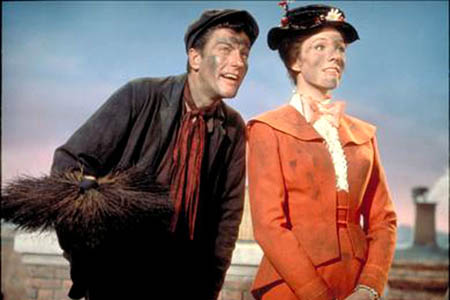
By the way, the image (above) of Dick Van Dyke from Mary Poppins was chosen because he put on the www.google.com/search?q=worst.british.accent.ever">worst British accent ever.
One of the major milestones in my life was moving from Dallas, TX, where I grew up, to Brooklyn, NY. I arrived with a pretty thick Texas accent. But I loved the Brooklyn accents I heard and would follow folks around Prospect Park listening to them talk, and very quietly imitating their accents. After several months of this I found that a Texas accent and a Brooklyn accent are 180 degrees out of phase with each other and I wound up with no accent.
I live in Atlanta now and the Southern accent has crept back in;^)
What about our British actors invading you drama series.. like Hugh Lawrie in 'house' and Eddy izard in that other show.. is it just us, or can Americans also spot the dodgy american accents.. ??
I'm in Brazil right now on a storytelling tour, and though I only speak a little Portuguese, I try very hard to get the sounds right. It seems like a mark of respect.
I lived in Bulgaria in the early 80s. I spent a lot of time listening and imitating, working at not having an American accent. One night, I dreamed in Bulgarian--but I didn't understand a word! I was learning the music of the language first. Though my grammar was never the best, because I got the intonation and phonemes right, people understood me. A Belgian friend spoke grammatically correct Bulgarian, but her intonation was off and people would give her that extremely quizzical look. Huh?
My family and I moved to Bombay, India when was 5, as soon as my brother was born. I stuck out like a sore thumb for the first three years and quickly adapted to the 'Bombay Indian' accent to avoid the attention I got whenever I opened my mouth (or so it seems in hindsight). That plan backfired for a while: the same kids who ribbed on me for having an American accent ended up ribbing on me for trying to sound 'Indian'. But I knew it was for a short time and a small price to pay to finally 'fit in' in my mind. So I had a very palpable sense of not identifying with either culture for a long time.
I don't have my indian accent in the States. Been here since I came back when I was 19 (I'm 34).
But I never really 'lost' it. I believe it's since I changed it very consciously.
Hi Derek, first of all, I've read your ebook and it was great. I'm not a musician, but an aspiring author and it helped me loads.
Second of all I'm a yoga teacher. I teach people how to feel their body and how to lead it into doing what we want it to do. I think language, saying thinks is another way of using the body (the tongue and mouth) to express something.
In line with a few of the other comments above, I think one key is learning to truly hear ourselves as we speak. Not what we think we are saying but what we are actually saying. Using recording instruments is an aid to this. If we use our recorded voice to calibrate what we think we hear with what we are actually saying we may be able to better mimic the accent we are trying to learn.
I spent some time learning mandarin (I live in Taiwan right now) and for the speaking side of it, if you have a good teacher who is able to explain tongue positions in plane language (rather than linguist techno speak) it is actually pretty easy to practice the sounds of a language.
I think those would be the keys to learning to get speak like a native. It isn't so much about having a window of opportunity as it is about taking the time to learn to listen to how we really sound and also learning to exercise the muscles we use to speak with, (and exercise them correclty.)
The key in both cases, (both sensing and doing) is to notice what we are doing.
I think this applies in anything we do if we want to do it well weather learning to play music or sports or do yoga or tai ji.
sincerely Neil
(oh yes, and thanks for the book list too, i'll have to write another response about that one)
Hey Derek, this is interesting! I've wondered about the same thing many times...like when my Spanish teacher was an American who butchered the pronunciation of words.
I am with you in that I create an identity with the culture I'm trying to learn. I want to understand it, to feel that I can participate in it and be accepted (by having an accent equal to the natives).
I speak Spanish fluently and speak with a Mexican accent because I imitated those who I learned from working in restaurants in AZ. When I was learning some Arabic I imitated the accent of the Lebanese people I worked with.
The reason for this...I wanted to fit in to their cultural profile. It really seems to make a difference too. In both language cases my friends would say 'hey Andrew speaks Arabic' (or Spanish) to their friends and want me to show them. This would create a warm reaction from the person and they would be impressed and want to talk more with me in their native tongue.
I think that people very much identify with their nationality. Some people just identify with it so much that they couldn't or wouldn't want to be able to be a cameleon in different cultural settings. It would be a betrayal of who they are. I guess I've never identified myself as being one thing. I want to be a shape-shifter and be able to adapt to whatever scenario I may find myself in.
That's my two cents...
Wow, this is a great topic! I'm a singer/voice teacher specializing in Eastern European folk music, so this is an area close to my heart--I love the details of language! What I've been told by linguists is that your soft palette (the part behind the roof of your mouth that itches when you experience allergies) forms by the time you're 7, and its shape is dependent upon your first language and what version/dialect (even accent) is spoken in your direct environment. Although your soft palette doesn't change a whole lot once its shaped, how you use it relative to your speech can. This explains why people--including many who have commented here--can take on a different accent later in life; environment is a strong factor in that kind of shift. Second most important, though, is an ear for that change (which also explains why some folks keep the same accent, no matter where they live). Tuning your ear to a sound makes you aware of it; your body determines how it will process it.
Though I was born in the States, I spent the first 6 years of my life speaking only Ukrainian, so my accent as a young child was pretty thick. It softened the more time I spent with playmates from Slovakia, and even more once I started going to school and learning English. Hearing me speak now, you'd never know that English is my second language--I'm about as Midwestern as you can get. But when I learn new languages (French, Spanish, Dutch, Bulgarian, etc.), I find that my natural instinct is to pronounce things as a Ukrainian would...until I've tuned my ear to the language in question and really made an effort to create those new sounds.
Isn't language fun?
Being a diplomatic child I lived in Yemen, Kenya, India, Libya and then finally at the age of 15 I moved to the UK to stay here until now...and even with that I spent time living in Edinburgh and Newcastle, both places with their own distinct accents.
I don't even know what my accent sounds like really, it's totally unique...it's mostly London though now with twangs of all the other ones...I thoroughly use the words "aye" and "wee" as I love them :-)
I moved to the States 13 years ago when i was 24 and truly worked hard learning slang trying to get rid of my Slovak accent. Then one day someone said to me "all Americans are trying to be different, you have this accent that makes everyone remember you..." so i relaxed about it. Some people can fake it, some are not as good at it. Credit to all those that can learn a second language, accent or not. And as for the identity, nationality is just a small part of the package.
The comments about facial muscles and soft palate formation in childhood are very interesting. In my own case, my parents loved French and sent my brothers and me to a French-English bilingual private school from age 5 to 11. I also briefly attended school in France in 7th grade, which cemented the language and accent -- from that point, I was said to have a perfect accent.
However, I always wanted to speak Spanish, a far more useful language here in California (and far more common now than when I was a child). I studied it in college and then met and married a Mexican. For a few years I had a French accent in Spanish. The interesting thing is, through the process of immersion with my husband’s culture and family I improved my fluency and eventually adopted a perfect low-class (there are more polite ways to say it, such as low-register) Mexican accent, replete with swear words that only a man would say.
Then I got a job working on a Spanish-language publication for doctors. Suddenly I had to work very hard (my husband being the first to point it out and tutor me) to stop swearing like a sailor (didn’t bother me in Spanish) and speak less street-style. Street-level Spanish from central Mexico is very sing-song. I still speak that way (now my children do too) but at least I have a vocabulary and conscious ability to sound more professional if necessary. Interestingly, I hate the upper-class female Mexican accent, which is the equivalent of East Coast American lock-jaw.
I could go on and on... In summary: Immersion is crucial to learning an accent. Accents reflect regions, class and education, so there are advantages and disadvantages to perfecting one. When you have a more generic accent, as in how I speak Portuguese with a muted Mexican accent, you avoid to some extent the regional animosities of sounding like a Carioca or Paulista or whatever.
And we didn’t really get into the musical aspects...
For me, it's about assimilation. Being a rebel is cool, but sometimes not good for survival. The tallest blade of grass gets cut first & all that.
I've found that by blending into the mainstream, it's easier to work from within a system rather than brute force it from the outside. Trust is more readily established when someone shares similarities, kinda like you mentioned in your conference blog.
If an accent can be effectively adopted, it can create an instant comfort zone in some situations.
Last time I was in Hawaii, I started speaking "Da Kine" & was often treated like family just because of that. At Chinese restaurants, my American-born friends who speak perfectly accented Mandarin often are informed about the specials not on the menu. Picking up on specific slang terms in the urban world, helps your street cred, when used in the proper context.
And THAT is where many fall short, becoming posers & wannabees, ridiculed as fakers who really don't care enough to be part of a culture, but pretend to be in attempt to be accepted.
That is sad.
Hey Derek,
I have not researched this subject scientifically, but from my observations I have become convinced that musicians are generally better at learning languages than nonmusicians. We are trained to listen to rhythms and melodies, analyze them and recognize aural patterns until we can successfully replicate them - all skills that pertain directly to learning a foreign language.
I have always been fascinated with the way the brain works, and particularly the way we learn languages. After Berklee, I decided to run an experiment: I moved to Paris, France, knowing only a few phrases of French; and I was going to see if I could learn the language without any formal study (language courses, memorizing vocabulary and grammar rules, etc.). My family and most of my friends thought it was a ridiculous idea, but I was fluent within six months.
I was born and raised in Germany, but have lived in the U.S. for almost ten years. I actually find it easier to express myself in English than in my native tongue. I still have a slight accent (which I will probably never quite get rid of), but it usually takes people I meet a few minutes to say, "your English is really good, but... where are you from?" I often ask them to guess, and they can almost never place it.
I believe that these people who act different as to the issue should be respected as long as they take it naturally and freely as to their beleifs, but it is pathetic if they do it to please others and recieve their approval to stay in the foriegn country. Id that person enjoys imitating the forien accent then let it be, and if not, then his attitude is: "take it or leave it". Just act as you wish, don't try to please others to get their approval, love your self and who you are, that is the real good inner life.
Well, we've all got different motivations. More than you're going to get represented in the responses, I'm sure.
I'm a California native English speaker who always gets positive comments on his Spanish accent from native Spanish speakers.
In my case, I think it's a combination of perfectionist tendencies and love of sound and language. I want to honor the tradition or core or spirit that brought forth and developed this beautiful set of sounds.
(I'd like to do it with French, but I don't have the time or energy - sorry - you don't want to hear me mangle French.)
The meaning is another matter. It's utility or aesthetics, and I don't think the Governator feels he needs to fit in, but maybe he is enraptured by the sonic quality of what we call his "mother-tongue". He probably feels a stronger sense of identity speaking in his native accent.
My best Jewish friend from New York, though, get him with the family for a while, kibbutzing (sp?), arguing - doing what they do, and eeesh - the accent has taken ovah again.
Hey, Derek,
I agree with a lot of the points that people have made in their comments. Personally, I like learning new accents, and dissecting them and figuring out where the nuances are. Like, why is there an "r" placed at the end of some words that end in vowels in the Northeast and England? (I think it's a separator mostly used if the next word or syllable begins with a vowel)
I'm from Texas, and everyone I know has the "ugly" accent that I hated, but my best friend's family was from Brooklyn, so it was always funny to us to mimic things they used to say. I picked that one up all through my high school years. I'm assuming it's because I was immersed in it.
When I moved to Japan at 19, it didn't take long for me to speak like a native, and that would have never been possible without the help of native friends, I believe.
Immersion is always key when learning a new language, in my opinion. But when you immerse yourself in the language, you start identifying with the language and culture. I guess the short answer is "identity" from my standpoint.
But then again, I found it fairly easy to pick up other languages from other native speakers - I got a little Vietnamese, Korean, Thai, French, and Spanish, but I was never immersed. Maybe the interest and pursuit of learning other languages with focus on the accents is another huge factor.
When I came back to the States at 25, it was sometimes hard to express myself in English! But I've been in Texas for a long time now, so when I speak to my Japanese friends, they tell me that my Texas accent is creeping in.
誰か、日本に戻してくれ!
My first language is Spanish. I moved to the United states from Peru when I was 13. I had taken some English classes before that but I was horrible at it, still, I came to the US with some previous knowledge about the language. When I started 8th grade I thought that by the time I would finished high school I was going to speak perfectly good English. I'm a freshmen in college and I still have a foreign accent. My friends say they can understand me well, and I have no trouble communicating, but one can tell that English is not my first language. I love myself and a everything but just lately I've been wishing to get rid of my accent. Being a Latino with an accent is not very convenient. People automatically assume "Illegal immigrant" or that I'm stupid because I can't speak their language well, and I hate it.
Hi Derek,
I'm 26 years old. I grew up speaking English and Spanish in Panama with an American father and a Panamanian mother, so English was no problem for me when I moved to the States when I was 15.
My friend in the States wanted to learn Spanish and I would sometime speak Spanish with him. He used to ask me why would I have this stupid, high-pitched voice when I spoke Spanish and why couldn't I just use my "normal" voice. For the longest time, I didn't know what he was talking about, until I just started speaking Spanish with an American (English) accent and he yelled out, "THAT'S IT!" Thinking that you sound stupid when you try to imitate the accent of the language you are trying to learn will not get you anywhere in sounding like a native. Perhaps that's a problem that many people have when they learn a language.
Anyway, I've been studying Mandarin Chinese for two years. I've been in Southern China now for almost three months and the most surprising thing is that a lot of people tell me that my pronunciation is so "standard". This one old man even got really close to me and was inspecting my face to see if I was really Chinese after he had heard me order some food. I do have to thank my Chinese friend in the States for that, because he drilled me on pronunciation, and made me practice over and over.
So it is possible to learn a language in your twenties and be somewhat decent at it, as long as you get proper training, practice, and let go of your prejudices.
Hi Derek
I am a Scouser - but emigrated to Perth Western Australia - ( the world's most isolated City ) nearly 20 years ago now. My accent is still strong but you pick up and use local sayings and phrases to communicate with the natives and it is their use that make family members and fellow Scousers think you sound like a true blue Aussie. I find with an accent people tend to listen to the tune and not the words - I have spent a lot of time repeating myself. The one exception to this I have found to be two words that seem to be understood globally regardless of accent the second of those words is off. ;o)
I am a Chinese student who studies abroad. Although I know it must be strange to hear my speaking for a native since I had that feeling when somebody speaking Mandarin in a weird way. But it's very difficult to get a perfect English-native accents for me and most Asian students.
Oh MY GOSH!! I have TOTALLY felt this way!! I have said almost the exact words you did and mentioned this to many people sooo many times. When I came across this, my jaw dropped lol. I speak Spanish, but I have a (tiny) foreign (american) accent. I am learning Greek (at 28yrs old), but have no foreign accent because, I believe, my family speaks it, I've heard it, though had never understood it, my whole life, and I feel like I have more of a right to "be" Greek, i.e., act Greek, use Greek gestures, make Greek facial expressions when I speak, etc. With Spanish, I feel like I'm trying to fit in, like I am not one of them. I don't feel as comfortable expressing myself exactly how a hispanic person would. I cannot totally adopt a hispanic identity. But with Greek I feel like I can totally immerse myself into a Greek persona, almost as if I am a completely different me, but still totally me at the same time. I feel as though I'm me from a different life or time or something...but with the same wants, dreams, beliefs, etc....almost like I have a Greek twin. Me, but a different flavor...this has been something I've wanted to explore for quite sometime now, I'm so glad I've come across this!! :0)
They might not be able to make the foreign sounds. I remember reading that if you haven't learned to make a sound that's not in your native language by the time you're 21, you're unlikely to learn it.
I speak some Norwegian. I can make the å sound and the ø sound, but the vowel sound æ is something I can't seem to do, and I've tried for years. To myself, I'm copying them exactly, but they tell me I'm still not saying it right. I guess I'll always have an accent even though I've practiced since I was 8 years old.
You got it! Flexibility in constructing new linguistic and cultural identities is the key to approaching a native-like accent.
Some people are sound oriented as others are more visually oriented. This means the thought process of learning a new language is to remember visually the written word, and so they just say that out loud, not even paying much attention to how it sounds.
Other people are more attuned to the sounds (I imagine you are, being a musician, although some musicians aren't), so they make an extra effort to sound better - no accent - because it bothers them to do otherwise. Some might be sound oriented and just like the way their accent sounds, but my guess is that for most people they are not aware of that, they're focused on the visual words, not on the sound they produce.
Part of accents and language acquisition is hearing.
When I was taking French as a teenager we were supposed to roll our R's. I couldn't do it. One day I asked, "Is that anything like rolling your L's? (because I could do that) Turns out this is no rolling of L's, I was doing R's all the time without knowing it.
Years later, thinking back, I suddenly got how Sino-Japanese people have trouble with English r's and l's.
...You know how if you are the only white in the room you forget until you look in the mirror? I used to keep forgetting I had an accent. But people have asked me so often down the years that now I remember.
I can't resist adding some comments:
As for learning words for "street credibility," nobody minds that I am a university graduate, although I do find myself trying to blend in, saying huntin' for hunting, and "I go" for I said.
Nevertheless, I forget that I sometimes use big words that folks don't know, until once in a while people tell me I have been doing so. Don't worry, they still like me, because I am not arrogant.... My college department head would start using big words, natural to her, whenever she was tired!
My favourite prison warden, Clinton Duffy, never use convict words and slang, he spoke formally, and the cons still respected him. I often follow his example.
When I was a teenager I knew two sisters from Eastern Canada. (Newfoundland and Labrador) One had an accent, the other didn't. Why?Turns out the one sister used to hang around people with no accent, while the sister I knew best hung around locals who had an accent, whom she was loyal to. When we were talking about this she said, "Oh, don't lose your accent!" so I never did. Although I would if I had to teach English overseas.
When I sing songs from the radio I can sing in the accent of the singer. At least, I think I can.
A college classmate in geography, during a class presentation, told us that for so-called "bilingual countries" what is often the case is that the country is divided into "unilingual regions." I think this would be reflected in their armed forces.
I remember a soldier from the U.S. south addressing us when we in a base in the pacific northwest (Fort Lewis) and almost the first thing he said was, "Can you understand me?" We could, with great difficulty.
You know how, magically, all the firemen are good looking? When my commando was transferred to French Canada we all said that, magically, all the French girls were good looking... Looking back, I think it was partly because the language did things to the muscles around their mouths.
Like the radio song Seven Days in May, "Lord, she loved the lines around his mouth."
Oops, I meant "Five Days in May" by Blue Rodeo.
"Seven Days in May" was a 1964 movie and a novel: I read the Readers Digest condensed version (with pictures) as a boy. About a conspiracy to take over Washington.
At the time, President Kennedy said to a friend the book's plot was feasible if the government had made several mistakes in a row, which would lower public confidence and loyalty.