Circle of influence — Circle of concern
There’s a great metaphor in the book “The Seven Habits of Highly Effective People”.
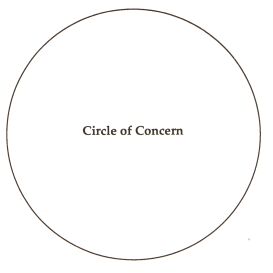
The author says to imagine a circle that contains all the things you care about:
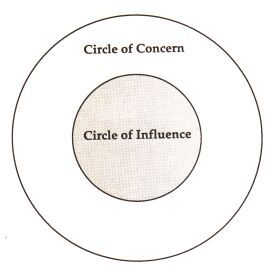
Inside of it, imagine a circle that contains all the things you can do something about:
Your goal is to either expand your ability to do something about the things you care about...
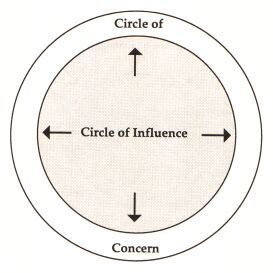
... or shrink your circle of concern — meaning: stop caring about some things — so that you don’t care too much about things you can’t do anything about.
It’s an interesting metaphor I’ve thought of often. But the most interesting part, to me, was at the end where he said that some dangerous individuals’ circle of influence is actually bigger than their circle of concern. They are affecting more than they care about, often unintentionally hurting others in their path.
I’ve felt like that a lot over the last six years. I employ 85 people at CD Baby. I’ve never even met half of them. Clients I don’t know get hurt because I never replied to an email I never saw. I started hiring the services of a small company, then changed plans, and found out that my change-of-plans sent them into default on a bank loan, practically destroying their company. Etc.
I’m dangerous. I’m trying to be more cautious. I really do think of everything from the other person’s point of view, but man it’s hard to take every affected person into consideration for every decision.

Dear Derek!
I don't think it is possible to act in this world without the danger of harming others. Even if one has such high moral standards like you. And even if one's circle of influence is small. I have thought about this a lot. All you can do is try to be caring, loving. That is a lot already. The best one can do.
But even then, not all that's happening is within our control.
Once I start acting in this world, there is interaction.
In your example with the company that was destroyed because you stopped hiring them, it looks like you did something bad. But is that really true?
What if that initially bad situation made the owner change his business completely or start a new one that worked much better for him?
I have no idea how everything in this life is connected.
But I learned that it is impossible to do everything right.
The only way to do that would be to stop acting. To freeze.
Then all the beautiful things one can create ( like you did with CdBaby i.e.) would never exist!
When I was younger, my circle of concern was huge, and my circle of influence very small. That meant suffering. Feeling like a victim.
Shrinking my circle of concern and at the same time expanding my circle of influence has given me more peace and gratitude.
Thank you for sharing your thoughts!
Herr Sivers,
I’ve known this about you. But you knew that; as far as consideration – It is usually circumstanced by the larger spectrum regardless, of intention.
You’re not where you are because you are the nicest person; but you are definitely a pro-active, self-empowered individual. For that, you exist uniquely.
There are no principles or moral values to it, outside of persuasion that way. I think that is a powerful distinction between you and 300,000 others.
I’m proud to acknowledge you as a leader that way; which is why I’ll never praise you, or like in some of my previous emails, make you feel that you’re ahead.
There is always something more to encapsulate…but you are a very good enterpriser.
Respectfully & Sincerely,
- Ss (Your much eviler twin)
leitung@sekrettscilensce.de
www.sekrettscilensce.com
*
admin@filmtvman.com
www.filmtvman.com
I just realized : this is a big reason why I don't like investing in the stock market : it's out of my control! The circle of concern is much bigger than the circle of influence.
I prefer to get my income from my business, so that my circle of concern is within my circle of influence.
This is all - greater game. And who you are in it - here the main question. All these circles and ideas are traps with which our mind arranges, leaning on the conditionality and not skill to see the world completely. If that you do, does not please you, the conflict will be. And the income turns to the big charge.
Hi Derek, I find it interesting how you balance so many "found objects" from a variety of sources, and make sense out of it. I surely go read when you notify me. I trust that your ideas, contemplations, and experiments would result in some new great projects, which will be exciting to find out about.
i read the same info at one time in my life about these "circles". i know first hand how difficult it is to make the right decisions based on what you REALLY want to accomplish. FRIENDS are the first tested in this scenario.
we choose to go down a path that will lead to some type of success. the nature of some of these paths require amounts of time & dedication. friendships are both concerns & influences, which makes things hard to stay on our journeys to success. a true friend will not harass you for time when you don't call them for a certain time. they will call you to check & see if things are alright with you or if you are in need of something. when one is on a path that involves growth or change their path to a more successful plateau, people naturally want to see you fail. it is up to you, to determine what is most important to you. it's all hard work, following your path & maintaining friendships; in some cases, even personal relationships.
in this day & age, people are moving in the 'fast-paced-lane'. commitments are thrown out the window. this doesn't only mean relationships; it also includes, but is not limited to, personal endeavors. in the event of pursuance, remember who TRULY stands by you; don't forget your loved ones; don't forget the little people; thrive on the energy of those that will want to see you fail; stand strong in the face of those who doubt your abilities. you are the expert of your journey, everybody else don't know what you know. unless they have already traveled down the EXACT same road, they really can't advise you; they're only holding you back.
Derek,
I just got an CDBaby email invitation from you and only checked out your blog today for the first time. You have some intriguing and provocative things to say, and I appreciate your willingness to be up front.
Regarding the circle of influence versus the circle of concern, I agree that feeling deeply invested in many things beyond one's obvious control can be discouraging. On the other hand, I think it may be illusory to think that one can simply "stop caring" about things one cannot directly impact. For example, anyone concerned about the 1.1 billion people without access to safe water or the 2.6 billion without access to adequate hygiene might as well give up now and go find a hobby, because this problem will likely only grow in our lifetime unless world powers (especially the US) dramatically change.
So, should I stop caring about this problem? I don't think so. I think a compromise is to continue caring but acknowledge that I cannot solve the problem--and yet--I can contribute something positive. As one personal example from my own life, I do this by serving as a Board member of Lifewater.org, a faith-based development organization that works with local partners in developing countries and teaches, equips, and empowers them to provide their own communities with safe water, hygiene, and sanitation (teach to fish versus give a fish). For instance, we have been working with a very large network of churches in Ethiopia who have become so effective at doing trainings themselves, that now the Ethiopian government has requested that this network of churches begin training all the NGOs in the country. When placed in the context of the billions who are lacking safe water and/or sanitation, efforts like these are clearly a drop in the bucket. When compared with doing nothing, however, I remain convinced that caring has produced a significantly better result.
I do agree, however, that focusing on concerns that focus on my own wants, when they are beyond my control, can tend to encourage a “victim” attitude which, counterproductively, can encourage even less action on my part. In this way, I support your ideas that reducing our circle of concern can be helpful. When I think of my “concerns” in the context of the billions of people with so much less than I have, this can effectively reduce the expanse of such “victim-concern” feelings and motivate me to be more thankful for those areas of blessing and/or control that I do enjoy.
So, in short, I guess it’s a question of whether one’s circle of concern focuses primarily on oneself versus on others. I know that may sound sappy to some, but I am convinced that it does make a difference. Thanks again for raising important issues like this!
Peace,
Jeff Bjorck
Seems to me the more you work in an expanding social structure the more responsibility you incur. It tests and bends the best of people. I think that life's more of a balancing act the more you take on. Consider yourself considerably blessed if you are ambidextrous.
Hi Derek!
Thank you for the links to some very interesting articles and news about you!
You really have a pioneer spirit that is restless and longs to conquer new challenges. You will succeed with anything you undertake, as you know the value of hard work and take the time to research, plan and then achieve your goals. You are a very generous mentor and have helped so many musicians to realize their dreams by sharing your knowledge with them.
I am so happy to know you and wish you every happiness in your search for new dreams to fulfill.
Love and blessings,
Carole Spiller
www.speciablendz.com
Derek,
I too love the circle concept. I have a house that I'm so obsessed with keeping because it takes all my pay to keep making the payments on the mortgage, insurance, taxes, oil, etc so you are inspiring me to divest myself of the things that really don't mean so much and then life becomes much simpler!
This is the curse of being a manager, no? Although I suppose some of use avoid getting to your level (as if it were so easy ;-)) precisely because we'd rather not be making decisions that affect so many other people.
Your optimism and kindly style is starting to work on me Mr Sivers. I've really enjoyed these articles.
I’m dangerous. I’m trying to be more cautious. I really do think of everything from the other person’s point of view, but man it’s hard to take every affected person into consideration for every decision.
The thing is, though they may be affected, they're not free from their own responsibility, either. We must do what it is we feel we must, and bank loan or not, others will be fine. Compassion and consideration are one thing. But don't take on TOO much. ;)
Derek,
I found this post through some research I was doing for my own blog. Teaching responsibility to our children and holding ourselves accountable for our actions is a foundational concept for our parenting. As you've expressed, change occurs through our actions and it can be positive or negative.
Some of us are born to lead and no matter what we do we have more influence on others than we intend. We are entrepreneurs, we produce and cause things to grow. It's the unfortunate by product of our nature that we can have such a profound and unintended impact on others.
I'm learning to cope by evaluating the truth at the center of my intent, and I believe that a person's faith must play a part here. While it may be the destiny of some to be great leaders, I believe strongly that it cannot be a goal.
If you listen, love, help, and learn then that is the best you can do. I think that learning is too often left out of the equation. I am inspired by your self analysis.
7 habits is an incredible book and will revolutionize anyone's life assuming they can swallow the "bitter pill" as Covey himself calls it. There are also numerous speeches he's done paraphrasing the book that I'm sure you can find. Usually runs about three hours so it's a good way to "sharpen the saw" (habit 7) and stay on top of things regularly. Also, I'd recommend "creativity:unleashing the forces within" by Osho. Very eastern in mentality. Osho can be a little extreme, but in a beautiful way. He's extremely easy to read and he doesn't care for you to memorize his words or strategies. Like Covey, he's just painting new pictures of the world around you creating paradigm shifts. As Covey said, if you want or need drastic changes in all aspects of your life then behavior isn't the way to go. Change the way you see things and your actions and the world around you will drastically change.
PS-Covey would never encourage a shrinking of the circle of concern. By focusing only on your circle of influence it will naturally expand larger and larger. But if you focus on concer it will dwarf the circle of influence. It's basically a feed the one you want more powerful. But you are absolutely right. He does mention people with more influence then concern and that's a bad boat to be in. Like a rich dude with servants he doesn't care about and stuff--influence, but no concern.
7 habits just basically says
1.be proactive--response-ability. Ability to choose your response
2.begin with the end in mind--no a "scheduling" thing. He warns a lot about schedule obsession. It's more of an integrity and direction thing. Leadership. Not management.
3.put first things first--stick to the program. You don't manage people. You lead them. Ethics and character over profits and bottom line.
4.think win/win--we have "emotional bank accounts." we need to be making far more deposits than withdraws. This is the failure of most relationships and trusts. Win/win or no deal. Prevents manipulation.
5.understand the other party first--(name for this habit left my mind). Basically don't go up to people and push your opinion before hearing them AND repeating it back to them more clearly than they gave it to you or you can ensure a major withdraw. Not to mention listening to them first is a huge deposit.
6.synergize
Sorry. Idk what happened.
6.synergize--sum of parts is greater than the whole. 1+1=3+ this is the theory behind the win/win philosophy. Opposite of a compromise. Compromise is more like 1+1=1.5. The only difference between synergy and a compromise is the emotional bank account element. When you "compromise" with someone important to you and both parties are getting at least part of their original intent they are also getting the satisfaction of knowing the other person is getting their needs too and that makes it much more powerful than a compromise. Covey goes into depth about all of this and I can't do it justice.
7.sharpen the saw--stay on top of things and keep it all fresh. He uses the analogy of a man working for hours and hours with a saw on one tree and someone suggests sharpening it and the guy responds "I'm too busy sawing this tree to sharpen it". Basically saying there's no point in running through life with a dull brain. Keep it crisp. Be proactive and go back to habit two and keep your direction(leadership/planning) then go to three and apply the plan (management) and repeat
WOW... This blog is simply a valuable tool! It will be in my weekly rotation until...
I have to quote T.I. with regard to the average CEO "Your unhappy with your riches because you're piss poor morally"
This does not apply to you here. There is as much value in your blog readers comments as there is in your actual blogs.
Much appreciated!
Your assessment of Circle of Influence and Circle of Concern is my Favourite.
Thank you
Paul Smart
Hello.
This is too big for me to write about. But let me try just one small thing:
liaison.
From business guru Peter Drucker I got the idea that for every decision I decide to implement, I should ask, "Who should be told about this because it's going to effect them?" Drucker's idea was to make this a business-lifestyle habit. It's not a natural habit to acquire, and some will never be able to pull it off. (Like my foolish relatives)
I don't exactly know, but I suspect that during the Great War this was so hard to do that the allies resorted to having a liaison officer stationed at the allied headquarters hoping to get needed information passed on.